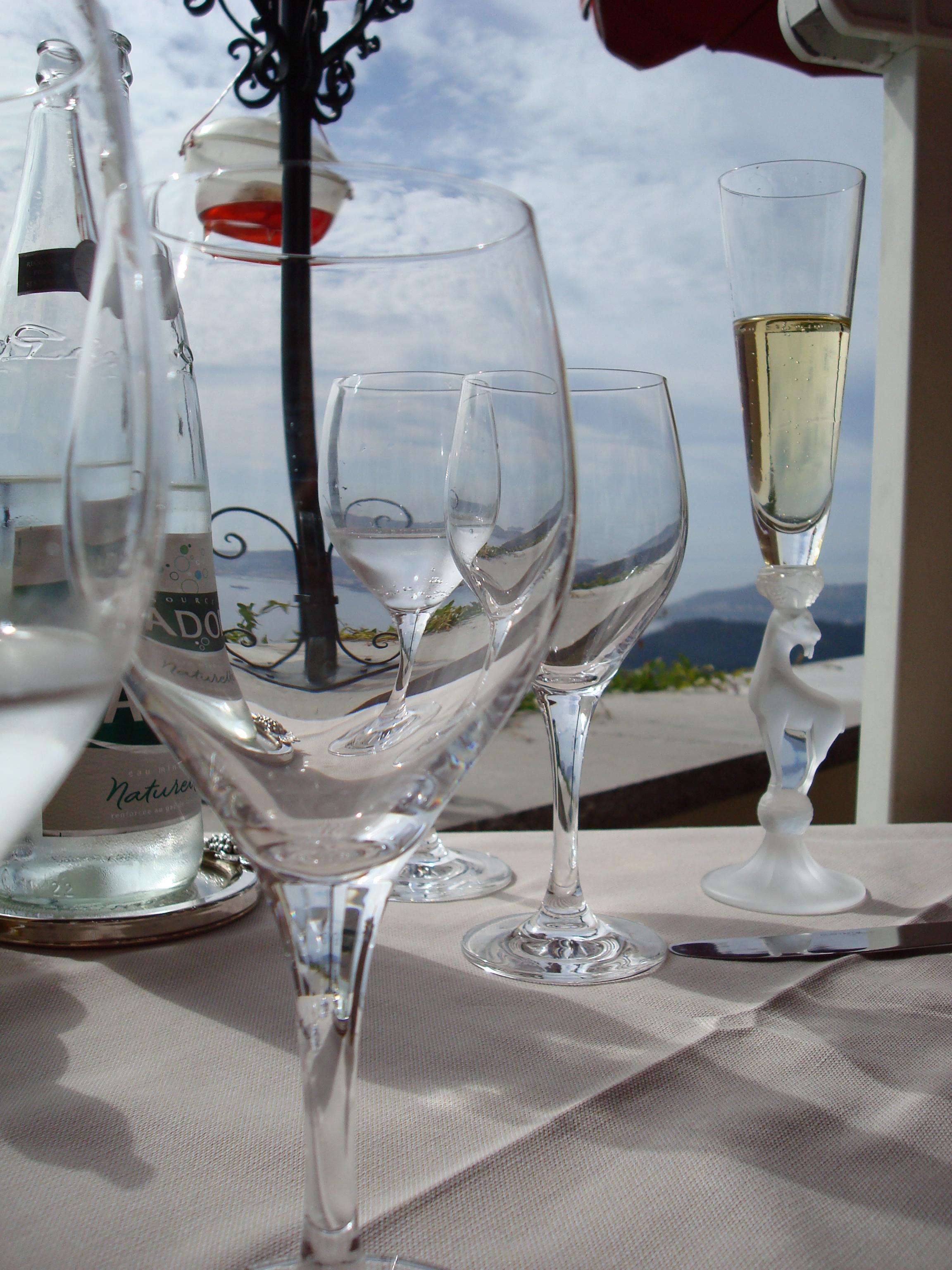
Champagne on the terrace at Le Château de la chèvre d’or, Èze, France
It was our twentieth wedding anniversary and our Mediterranean cruise was set to take us along the French Rivièra. Art had been there before, but it was Patty’s first visit, and he wanted to make it special by taking her to a magical place he knew that she’d enjoy. His destination: Èze, a medieval hilltop town overlooking the azure waters of the Mediterranean, and more specificallyLe Château de la chèvre d’or, a Relais and Chateaux property with a spectacular terrace boasting two Michelin stars.
Our young driver Caroline dropped us at the cobble-stoned entrance to the city where we’d begin our climb, on foot, to the top. We often walk through these destinations where the history oozes from the walls and ponder what life might have been like in the fourteenth century in a village that actually dates to 2000 BC! Sometimes it’s hard to summon the feeling, but not in Èze. Every step took us back another century to the fourteenth century when the first buildings that are still there today were built. At just over 1400 feet elevation, the hilltop village is crowned by an exotic garden that we visited before our lunch at the chateau.
That lunch began with the waiter asking us if we’d like to begin with champagne. But of course! So he wheeled over the champagne trolley and asked us which would be our pleasure. We chose, we drank (in their bespoke crystal champagne glasses with stems shaped like goats – in case you missed it, the French word chèvre means goat, and chèvre d’or means golden goat), we enjoyed, and we nearly swallowed our tongues when we realized at the end of our lunch that the two glasses of champagne had cost more than the rest of the lunch – including wine – all together. But we laughed. It was worth it for the experience.
Then it was wonderful to share Eze with son, Ian.
So we savored every moment, thinking that we’d never return. We lived in the moment taking in all the sights, sounds and tastes. Then, our son moved to France at the age of 21. He moved to southern France. He moved to Beausoliel so he could work in Monaco. And we visited him. And we took him to Èze to experience the village. And to lunch.
Our experience the second and third times were just as magical, but we learned one very important lesson through this: make every travel moment count. Feel the experiences in the present moment and just really be there. Step away from looking at everything through your camera lens for a while and really make a point of remembering. It might just be the only time that you’ll have that experience. And it will stay with you to take out and think about any time you like in the future.
The Discerning Travelers strike a pose on board a Celebrity cruise ship on a designated formal night.
Some people like a kind of laid-back beach holiday that finds them schlepping around in a T-shirt and shorts with a cold brew always at hand. Others have to sky-dive or parasail or bungee jump every day. We are travelers of a different stripe. We like to drink great wine, walk for miles and miles exploring new and now-familiar cities, have new experiences, sample a new cocktail or two – and dress for dinner.
There’s something just a bit sad about how people “dine out” these days. Just recently, we read a blog where the writer suggested that dinner is really only about the food. Well, we respectfully disagree. Dinner is about dining, and dining refers to a whole lot more than eating. You can eat anywhere, including your couch. Discerning travelers are also discerning diners. We are interested in the whole experience. Where we eat and the surroundings are as important as the food, and part of those surroundings focus on what you wear when you eat. Cruises are a prime example of what, where and how one can eat.
The very first time we cruised, we were bemused by the vast number of people who chose to remain on deck in their bathing suits all day and most of the evening, leaving their deck chairs only long enough to load up their plates at the nearby buffet, returning to sit on the edge of the chair, face in their plates, chowing down through the pile of food. (Presumably they then leave to use the facilities – but we are only guessing here). Food for us is much more than eating, and dressing for dinner is one of the pleasures of both land and sea-based vacations.
This past weekend, we took some time to make a few decisions about what to pack for the upcoming vacation that will put us on land in Puerto Rico for a few days and then at sea through the Caribbean, up to Bermuda and then farther up to New York. Packing for a cruise has its special considerations as we peruse the various ‘dress codes’ that cruise lines use.
Cruise lines seem often to have a language of their own. Every cruise line has in its FAQ’s a question that goes something like this: What is the dress code on board? The answer depends on the line, its brand and its target market. Let’s look at a few.
Formal night on the Regent Seven Seas Navigator.
Some cruise lines have begun to distance themselves from the more formal evenings, which is a shame in a way, but we do recognize that there are people who don’t find it fun to get dressed up. If, however, there is a dress code in the dining room, you’d do well to follow it, or risk the stink-eye from fellow cruisers, or worse, ejection from dinner to a more casual corner of the ship. Some cruise lines actually refuse you entry to the dining room if you are not properly attired (God love Cunard) while others seem to turn a blind eye (although, rest assured, other passengers don’t and you’re being disrespectful of their experience). So, if you don’t like to get dressed up, pick a different line!
Regent Seven Seas cruises that has played host to us on two vacations over the past three years is a six-star line that has gone to what they call “elegant casual” for every evening with “formal optional” nights on longer cruises. On this kind of a cruise line, people do follow the dress code, and many cruisers who prefer the more laid-back approach of say NCL, might find the dress formal even on elegant casual nights. Their dress code says, “Attire ranges from Casual to Formal Optional. Casual wear is appropriate for daytime onboard or ashore, and consists of resort-style outfits. Casual wear, including shorts and jeans, is not appropriate after 6:00 pm, with the exception of the final evening of the cruise.”[1] The cruisers on Regent do take appropriateness seriously.
Patty and son, Ian, descend the central staircase on Cunard's Queen Mary 2.
Silversea, a line we have traveled on only once last winter, another six-star line, has this dress code: “Evening attire falls into three categories: casual, informal and formal. On casual evenings, open-neck shirts, slacks and sports outfits are appropriate. On informal evenings, women usually wear dresses or trouser suits; gentlemen wear jackets (tie optional). Appropriate formal evening wear for women is an evening gown or cocktail dress; men wear tuxedos, dinner jackets or dark suits. On formal nights, guests dining in La Terrazza may opt to wear casually elegant attire (dresses or trouser suits for women; jacket, tie optional for men).”[2] Again, they take this seriously.
On Cunard last summer, formal meant formal. Full-length formal gowns and tuxedos far outnumbered the cocktail dresses and dark suits on the Queen Mary 2, and anyone skulking around in shorts quickly departed (and were not welcome in the dining room in any case).
Next week we’ll be aboard the Celebrity Summit, our third trip on this line. Our documents indicate that there are two formal nights on this eight night cruise and the rest are “smart casual & above” a category of dress that often baffles and leaves it open to serious interpretation. In general, however, this means no T-shirts, jeans, shorts or flip-flops. It means a summer dress or pants and fabulous top for women, and open-collared shirt with slacks and cool shoes for men. A really cool, above-smart-casual man will wear a jacket as well.
Formal nights for us mean evening gown and tux. Art always frowns when he has to pack his tux (he frowns only at the packing of it, not the wearing ), but this time he’s in luck. Celebrity has a formal-wear rental program and his tux with all the accoutrements (and he even ordered formal shoes) will be hanging in our suite when we open the closet door on Saturday afternoon. And it will fit perfectly: we know this from past experience. All it requires is for you to measure carefully and input the correct measurements when you pre-order online. Patty, on the other hand, will schlep formal gowns (or in this case one formal gown with two different optional jackets for ease of packing). A tip for formal gowns for cruises: when you’re shopping for one, always gauge its heft before you try it on. If it’s heavy, don’t even take it into the dressing room. Then if it passes the weight test, take a bunch in your hand and ball it up. When you let it go, if it still has creases, leave it on the rack. Remember, you’re not permitted an iron in your stateroom on a cruise ship. The best you’ll be able to do is go to a communal laundry room to wait in line for an iron. If it doesn’t pack well, don’t buy it. Then find several different kinds of wraps – better yet jackets these days. Wraps are cumbersome and usually look overly stuffy.
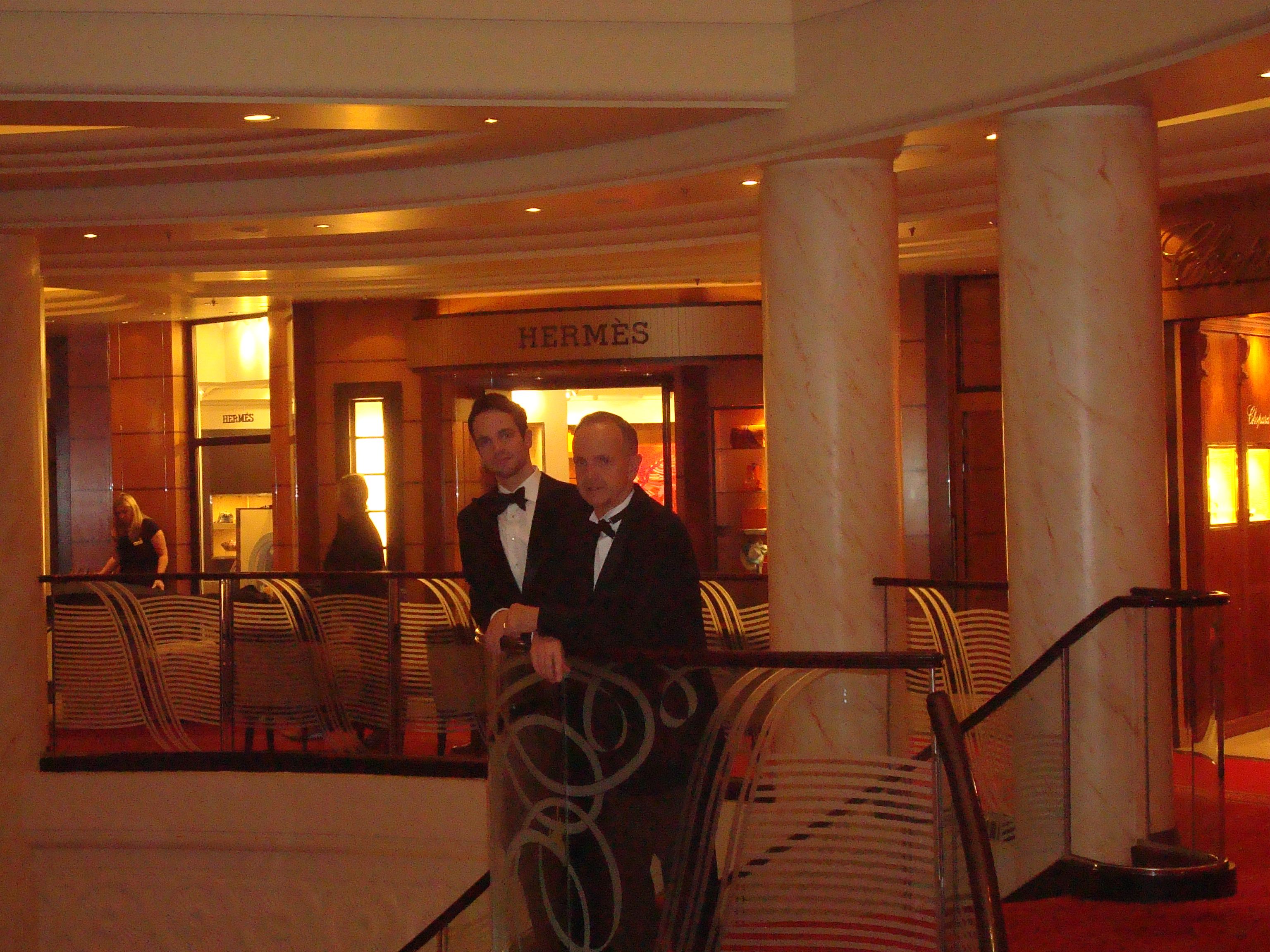
There's nothing better than the sight of a man in a tuxedo - unless it's two men in well-fitting tuxedos. Art & Ian onboard the Queen Mary 2.
The experience of dining in a wonderfully appointed dining room surrounded by people who have taken the time to look their very best for the evening is a vacation experience that everyone should have once in a while.
The tables at Gaylord's in Kauai are arranged around the inner courtyard of the plantation house under the porch awning. As the sun sets, the soft light of the torches begins to glow.
Call it social media, web 2.0, the inmates taking over asylum or whatever other terms (laudatory or derogatory: take your pick), but call it here to stay. And less than a decade has passed since everything has changed for us discerning travelers when it comes to making travel decisions. When we first started globe-trotting, we relied on two important sources of information: travel brochures and a trusty travel agent. These days, although both of these are important (brochures that have morphed into glossy magazines because it feels so darn nice just to turn the pages in an evening with a glass of wine, and our travel agent, Angela because we rely on her for getting us into and out of complicated trips), there is such an array of other information that it boggles the mind. So, why don’t we just ignore all those new sources of information? Well, that would be just dumb.
But the question still remains: how do you wade through all of the information? Our main concern is how to interpret the user-generated reviews; in other words, how do you discern the truth from reviews posted by fellow travelers? Not easily as it turns out. Here is our story.
Patty actually teaches social media to graduate students in communication studies at a local university. So, in our case, we do need to keep up with what’s happening. Over the past year or so, we’ve become regular reviewers on TripAdvisor, one of the largest (perhaps the largest at this stage) traveler-based review site for hotels, restaurants and travel experiences. That usually means that we also use reviews posted by others to get a sense of location, hotels and restaurants. The trouble is, after we’ve been to some of them and we go back to post our own reviews, we often see discrepancies that are not so much a function of differing points of view, rather they seem to be based on some reviewers not actually reviewing the right property at all! Here is our case in point.
The entertainment at Gaylord's.
In February we headed out to Hawaii in search of some warmth and relaxation in Kauai and the big island. While we were in Lihue on Kauai, we chatted up the concierge at the hotel to find dining options and decided to take a taxi to Gaylord’s. Located on the ground floor of a wonderful period plantation house on the outskirts of Lihue, this restaurant is a real step back in time. With top-notch service, wonderful food and evening entertainment in the open-air restaurant, the evening was memorable. And so on our return home we decided to post a review of the spot on TripAdvisor. As we usually do, we browsed other reviews before writing ours so as to add something that might have been overlooked by others. Much to our surprise, we noted several reviews that said things like this: “The show is stunning with beautiful music and stunning fire twirling. Food was buffet cafeteria style and not A+ quality…” Huh? Where were they? They certainly didn’t dine at Gaylord’s. However, they were on the property.
Be sure to visit the rest of the plantation house after dinner -- here is the great room.
At the Kilohana Plantation which is where Gaylord’s is located, there are luaus twice a week on the back lot. In fact, the evening we were there was a luau going on, but other than the cars parked out front, the crowd at the buffet-style luau didn’t interfere in any way with our own experience. However, this person who wrote the review (and this one was not the only one) certainly didn’t eat at Gaylord’s. This suggested to us that there might be many other mistakes like this one. Obviously, our review attempted to clear this up. But it begs the question of how to interpret what you read.
Here are some of the things we’ve learned about interpreting travel advice on the web.
Know what kind of site you’re on. There are many different kinds of travel sites. Among them are review sites from travel guide companies (www.frommers.com; www.fodors.com) where the reviews are written by professional reviewers ; there are travel review sites where the reviews are written by travelers (www.tripadvisor.com, www.virtualtourist.com); there are travel sales companies (www.maritimetravel.com), there are traveler blogs that are monetized (read: supported by specific commercial interests), and there are personal travel blogs like this one that are stories from travelers like you who simply want to share experiences). Each of these kinds of sites has a different agenda and each has something different to offer you. Remember, though, that each of them has a frame through which they see the travel industry as a whole, and specific experiences in particular. And each one wants something different from you. Armed with this information, you’re ready to move on into the sites you choose.
Get a feel for the kinds of reviews posted on the site. Before you hone in on the specific places you’re looking for, read as many reviews as you have time for. Look at how many there are for any given place and how often each is reviewed. There would be no point in you reading a review from us of a cruise we took on the Seven Seas Navigator three years ago because she has been completely refitted since then.
Examine who is doing the reviewing. This is particularly important in user-generated reviews. If you see a review that you think is useful to you, read the reviewer’s profile to find out if the reviewer might be looking for something different than you are. If you read our profile on TripAdvisor, for example, you can see that we are not interested in family-oriented places and seek the best of everything. If you’re searching for budget accommodation, our reviews will not be helpful to you. On the other hand, if you are an astute, discerning traveler, you just might find what you’re looking for. It’s also important to be aware that there have been some scandals involving property owners or someone working for them posting glowing reviews. Early this year the British Advertising Standards Authority censured TripAdvisor for suggesting that all reviews on the site are unbiased. (Read the story here.)This is a hazard of social media.
Beware of the one-sentence review. Anyone can slap up a sentence or two without really thinking about what made the experience good or bad. If someone says that a place was wonderful or terrible without details – telling you rather than showing you – move on to another review. These are not helpful. At least if someone relates their actual experience to you, you can judge for yourself. Some travelers consider places over-priced when what you really might be looking for is value for your money and be willing to pay more to get more. A review that simply says the food was over-priced without any details is useless.
So, now we need to get ourselves to a review site to search for wonderful restaurants that we haven’t already experienced in San Juan, Puerto Rico. Ten days and counting!
Our little hometown city of Halifax Nova Scotia is marking the 100th anniversary of the sinking of the Titanic this weekend because Halifax, Nova Scotia is home to the graves of more Titanic victims than any other site in the world.
We love our city for the little gem that it is — and promise to write a guide to visiting it some time before the summer tourist season starts. there is much to lure the discerning traveler and we do so love to play tourist in our own city from time to time. Today, however, we thought we’d share with you a remembrance.
On our office wall just to the left of the desk hangs a beautiful watercolor that captured Patty one day when she saw it in a brochure for a local artist. Finding Laurie Mireau in her Halifax studio, Patty was delighted to find that she still had the original of her painting of a deck chair from the Titanic, one of which is housed in the Maritime Museum of the Atlantic.
For us, the image is evocative of so many wonderful hours spent on ships at sea. Hope you enjoy it as much as we do. Laurie still has prints!






 The Discerning Travelers
You must be logged in to post a comment.