Is your casual ‘smart’? Cruise ship attire…take 2

There isn’t a cruise travel web site or discussion board that isn’t full of questions from first-time cruisers (and even more seasoned cruisers trying out a new cruise line) that doesn’t have a slew of questions about the appropriate things to wear on board.  And we say, “Bravo!” to everyone who cares –because we’re here to tell you that not everyone does! Our April cruise taught us that lesson.  Yikes!

The last time we took on the subject of the dizzying array of sartorial monikers in our discussion of dressing for dinner on board cruise ships, we reviewed some of the definitions of the various levels of dress expected (permitted?).

Art shows off his casual attire for going ashore in Monte Carlo – an onboard ‘smart casual’ evening look!

It’s fairly easy to figure out what to wear during the day because you really need to dress for your location and the weather.  If you’re in the Caribbean you’ll be more casual than if you’re visiting Rome, for example, on a Mediterranean cruise.  And you’re unlikely to wear a bathing suit on deck if your cruise is leaving from Reykjavik.  The most confusion is within the evening “casual” dress codes because day-time casual won’t cut it.  So, we thought we’d provide a bit of sartorial guidance – based on our ever-present agenda of generally improving the dress and behavior of tourists everywhere (Do we need to say it one more time?  White sneakers are for the gym.  Do you know what an embarrassment you are for your countrymen?  You know who you are.)

 What the heck is ‘smart casual’?

Could the cruise lines have chosen a more oxymoronic way to describe what kind of ambience they’re trying to create in the evenings?  There is usually nothing whatsoever ‘smart’ about casual.  What’s important to understand here is the objective: when a cruise line says smart casual for evening, they’re trying to have a laid-back vibe that doesn’t encompass what you’d wear on Saturday afternoon at home on the couch quaffing a beer and watching the game.  There should be more emphasis on the ‘smart’ part than the ‘casual’ part.  Step it up a bit, people.

Although the cruise lines try to define what they mean, we think people need pictures and a list of what not to wear (with apologies to Stacey and Clinton from the TLC television show of the same name).  Here are the things you should not wear on smart casual night:

There is nothing smart about this casual!
  1. Flip-flops.  How many times does it need to be said?  Flip-flops are not real footwear.
  2. Ripped jeans. On the cruise lines we prefer, jeans are not permitted in the dining room in the evening ever, even without rips. Just leave them for the day time please.
  3. T-shirts without collars.  These are for the daytime. The very least you can do is pack a golf shirt with a collar.
  4. Shorts, unless you’re a model and the shorts are Bermuda length.
  5. Bare stomachs.  We just put that one in because we think bare stomachs should be relegated to the beach and the pool – and even then only if you actually look good in that kind of beach wear.
  6. Pedal pushers.  This is the odd length of female trouser that flatters no one.  If you wear a slightly high heel, you can get away with a cropped, narrow pant.  That can look modern, but if you’re in doubt, wear either a casual skirt or a pair of full-length pants.

Then what’s ‘elegant’ casual?

Some of the luxury cruise lines have a dress category that they like to call elegant casual.  We like the sound of that, and although they do have a definition, most people on board the six-star lines have no need of explanation.  This is what they’d wear out to a casual dinner at home.  It’s a step up from the smart casual look, and just makes the ambience of the evening that much nicer without having to get dressed up as in the more formal evenings.

Our pictorial guide…

Smart casual on Regent. Art could lose the jacket for smart casual on a line like Celebrity.
Smart casual for women.
A smart casual look for women.
Elegant casual on board Regent.
Elegant casual – sometimes there’s little difference between smart and elegant casual.

A discerning guide to traveling close to home: Seeing Nova Scotia through new eyes

The iconic Peggy’s Cove lighthouse – with the Sou’wester Restaurant to the left.

How far away from home do you have to go before it counts as ‘traveling’?  Indeed, what are a couple of discerning (and inveterate) travelers to do when stuck in their offices, chained to their desks  for a few months with only the smallest of travel lights at the end of a seemingly endless tunnel?  We think that if they are true travelers, they can hop into the car, crank up the satellite radio and set out on a day trip that would make even the most jaded armchair traveler green with envy.  So, that’s what we did last week.

Striking out on the east coast of Canada is a no-brainer ; there are so many things to see and experience.

Sometimes we book a room at our favorite waterfront hotel downtown and spend a Saturday night pretending we’re tourists in our home town.  We have dinner, walk along the beautifully restored Halifax boardwalk and relish sleeping in and having breakfast served to us in the dining room with a front-row seat on the harbor.  Well, that’s for next week on Art’s birthday.  Last week, we set out around St. Margaret’s Bay, the home of Peggy’s Cove, and then around to Mahone Bay.

An iconic fishing village, Peggy’s Cove seems to be a tourist must-see in this part of the world.  The truth is that there are many just as charming fishing villages dotted along the Atlantic shoreline of Nova Scotia.  But Peggy’s Cove, at the entrance to St. Margaret’s Bay is synonymous with Maritime culture it seems.  It’s actually only a ten-minute drive from where we live, so we like to take a Sunday noon-hour drive there to sit at the Sou’wester Restaurant to indulge in fish and chips about twice a year.

The actual cove that put the ‘cove’ in Peggy’s Cove!

(We can’t justify following this lunch with their gingerbread – but you should try it!)In the fall, this part of Canada is subject to the ravages of hurricanes that make their way up the eastern seaboard of the United States.  This means that the day after a hurricane is the best time to sit and watch the grandeur of Mother Nature as she pounds the waves against the shoreline making mountains of foaming surf.

The other direction out our driveway takes us to Mahone Bay.  Larger than St. Margaret’s Bay, Mahone Bay is home to dozens of little islands, making it a haven for sail boats and small yachts.  We love to drive along, finding wonderful little places to lunch; and although we’re not ‘antiquers’ (as we’ve taken pains to mention before), we can still tell you that if you are, then you’re in luck because antique shops are dotted along the shoreline in many of the villages we pass through.

Where the Discerning Travelers day-trip.

Last weekend we were delighted to find a favorite restaurant had reopened.  Closed for some three or so years, The Galley, located at South Shore Marine, has reopened for business.  We did a U-turn in the middle of the road when we spied the ‘open’ sign so that we could once again sit in a window seat over the marina and watch the sailboats rocking in the breeze.  It’s a good thing that we didn’t have any hard and fast plans or we would have missed the best lobster rolls ever.  After lunch we continued on to our destination: the local nursery that stocks the best annuals and perennials in the area.  After a bit of shopping, we made our way home, happy in the knowledge that in spite of our currently busy schedules, we could find a short trip to take us away from our own yard.

A beautiful summer day on Mahone Bay, Nova Scotia

So, if you can only venture out for a day, here are our favorite tips for discerning travel in your own neck of the woods:

  • Don’t plan or at least don’t over-plan.  Although this is counter-intuitive to the discerning travel mantra, these kinds of trips are better left a bit loose.  We would have missed eating at The Galley last weekend if we had followed through on our loose plan to eat at the Seaside Shanty and Chowder House (which is kitschy and quaint).
  • Try something new.  This is your chance to turn down a road less traveled, a road that you’ve always wondered about.  Just go.
  • Take photos.   We’ve mentioned before that seeing the world through the lens of your camera might not make for the best experience of a place.  The truth is, though, that we often don’t take photos close to home.  This is a chance to turn this on its head: take photos of the things that you thought you knew.  Later, when you look at them, you just might see more-or-less familiar places from a different point of view.

Oh…and if you are actually planning a trip to the east coast of Canada (or will stop in on a cruise of New England and eastern Canada) we have a few suggestions for discerning travelers.  Here are a few of our favorites in and around the city.

Part of the Halifax weterfront

Favorite Restaurants: Il Mercato for chicken-filled ravioli and the best pizza anywhere, Da Maurizio for fine Northern Italian, The Five Fishermen for Nova Scotia seafood, The Bicycle Thief because it has the best harbor-front location.

Favorite Photo Ops: The Halifax Public Gardens, Citadel Hill, the Halifax-Dartmouth ferry from the middle of the harbor, Historic Properties, the Peggy’s Cove lighthouse (45 minutes from downtown)

Favorite Shopping Spots: Park Lane on Spring Garden Road (best shoe store in the city, ladies), Spring Garden Road in general (just stroll along).

But please remember: if you rent a car and take that day trip to Peggy’s Cove, remember that many of us live there and like to get where we’re going.  If you want to take in the views, please pull over!

Photo credit:

Halifax waterfront:  http://www.ecslcanada.com/UserFiles/Image/Halifax%20Images/Ship.jpg

Dressing for dinner: An eye on cruise line dress codes

The Discerning Travelers strike a pose on board a Celebrity cruise ship on a designated formal night.

Some people like a kind of laid-back beach holiday that finds them schlepping around in a T-shirt and shorts with a cold brew always at hand.  Others have to sky-dive or parasail or bungee jump every day.  We are travelers of a different stripe.  We like to drink great wine, walk for miles and miles exploring new and now-familiar cities, have new experiences, sample a new cocktail or two – and dress for dinner.

There’s something just a bit sad about how people “dine out” these days.  Just recently, we read a blog where the writer suggested that dinner is really only about the food.  Well, we respectfully disagree.  Dinner is about dining, and dining refers to a whole lot more than eating.  You can eat anywhere, including your couch.  Discerning travelers are also discerning diners.  We are interested in the whole experience.  Where we eat and the surroundings are as important as the food, and part of those surroundings focus on what you wear when you eat.  Cruises are a prime example of what, where and how one can eat.

The very first time we cruised, we were bemused by the vast number of people who chose to remain on deck in their bathing suits all day and most of the evening, leaving their deck chairs only long enough to load up their plates at the nearby buffet, returning to sit on the edge of the chair, face in their plates, chowing down through the pile of food.  (Presumably they then leave to use the facilities – but we are only guessing here).  Food for us is much more than eating, and dressing for dinner is one of the pleasures of both land and sea-based vacations.

This past weekend, we took some time to make a few decisions about what to pack for the upcoming vacation that will put us on land in Puerto Rico for a few days and then at sea  through the Caribbean, up to Bermuda and then farther up to New York.  Packing for a cruise has its special considerations as we peruse the various ‘dress codes’ that cruise lines use.

Cruise lines seem often to have a language of their own.  Every cruise line has in its FAQ’s a question that goes something like this:  What is the dress code on board?  The answer depends on the line, its brand and its target market.  Let’s look at a few.

Formal night on the Regent Seven Seas Navigator.

Some cruise lines have begun to distance themselves from the more formal evenings, which is a shame in a way, but we do recognize that there are people who don’t find it fun to get dressed up.  If, however, there is a dress code in the dining room, you’d do well to follow it, or risk the stink-eye from fellow cruisers, or worse, ejection from dinner to a more casual corner of the ship.  Some cruise lines actually refuse you entry to the dining room if you are not properly attired (God love Cunard) while others seem to turn a blind eye (although, rest assured, other passengers don’t and you’re being disrespectful of their experience).  So, if you don’t like to get dressed up, pick a different line!

Regent Seven Seas cruises that has played host to us on two vacations over the past three years is a six-star line that has gone to what they call “elegant casual” for every evening with “formal optional” nights on longer cruises.  On this kind of a cruise line, people do follow the dress code, and many cruisers who prefer the more laid-back approach of say NCL, might find the dress formal even on elegant casual nights.  Their dress code says, “Attire ranges from Casual to Formal Optional. Casual wear is appropriate for daytime onboard or ashore, and consists of resort-style outfits. Casual wear, including shorts and jeans, is not appropriate after 6:00 pm, with the exception of the final evening of the cruise.”[1]  The cruisers on Regent do take appropriateness seriously.

Patty and son, Ian, descend the central staircase on Cunard's Queen Mary 2.

Silversea, a line we have traveled on only once last winter, another six-star line, has this dress code: “Evening attire falls into three categories: casual, informal and formal. On casual evenings, open-neck shirts, slacks and sports outfits are appropriate. On informal evenings, women usually wear dresses or trouser suits; gentlemen wear jackets (tie optional). Appropriate formal evening wear for women is an evening gown or cocktail dress; men wear tuxedos, dinner jackets or dark suits. On formal nights, guests dining in La Terrazza may opt to wear casually elegant attire (dresses or trouser suits for women; jacket, tie optional for men).”[2]  Again, they take this seriously.

On Cunard last summer, formal meant formal.  Full-length formal gowns and tuxedos far outnumbered the cocktail dresses and dark suits on the Queen Mary 2, and anyone skulking around in shorts quickly departed (and were not welcome in the dining room in any case).

Next week we’ll be aboard the Celebrity Summit, our third trip on this line.  Our documents indicate that there are two formal nights on this eight night cruise and the rest are “smart casual & above” a category of dress that often baffles and leaves it open to serious interpretation.  In general, however, this means no T-shirts, jeans, shorts or flip-flops.  It means a summer dress or pants and fabulous top for women, and open-collared shirt with slacks and cool shoes for men.  A really cool, above-smart-casual man will wear a jacket as well.

Formal nights for us mean evening gown and tux.  Art always frowns when he has to pack his tux (he frowns only at the packing of it, not the wearing ), but this time he’s in luck. Celebrity has a formal-wear rental program and his tux with all the accoutrements (and he even ordered formal shoes) will be hanging in our suite when we open the closet door on Saturday afternoon.  And it will fit perfectly: we know this from past experience.  All it requires is for you to measure carefully and input the correct measurements when you pre-order online.  Patty, on the other hand, will schlep formal gowns (or in this case one formal gown with two different optional jackets for ease of packing).  A tip for formal gowns for cruises: when you’re shopping for one, always gauge its heft before you try it on.  If it’s heavy, don’t even take it into the dressing room.  Then if it passes the weight test, take a bunch in your hand and ball it up.  When you let it go, if it still has creases, leave it on the rack.  Remember, you’re not permitted an iron in your stateroom on a cruise ship.  The best you’ll be able to do is go to a communal laundry room to wait in line for an iron.  If it doesn’t pack well, don’t buy it.  Then find several different kinds of wraps – better yet jackets these days.  Wraps are cumbersome and usually look overly stuffy.

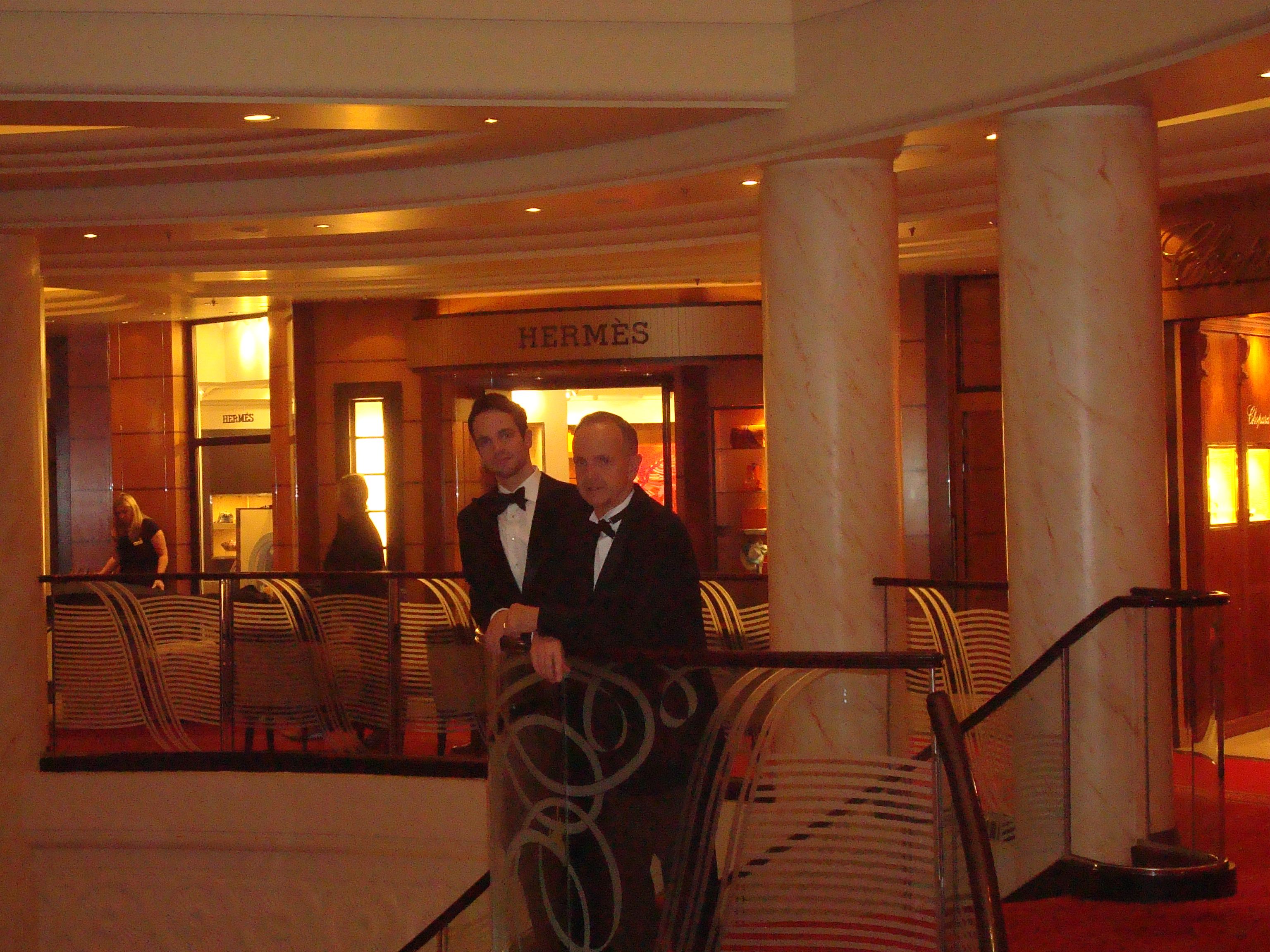
There's nothing better than the sight of a man in a tuxedo - unless it's two men in well-fitting tuxedos. Art & Ian onboard the Queen Mary 2.

The experience of dining in a wonderfully appointed dining room surrounded by people who have taken the time to look their very best for the evening is a vacation experience that everyone should have once in a while.

There's a little bit of "Gloria" in all of us!

A discerning guide to interpreting online reviews of restaurants & other things…

The tables at Gaylord's in Kauai are arranged around the inner courtyard of the plantation house under the porch awning. As the sun sets, the soft light of the torches begins to glow.

Call it social media, web 2.0, the inmates taking over asylum or whatever other terms (laudatory or derogatory: take your pick), but call it here to stay.   And less than a decade has passed since everything has changed for us discerning travelers when it comes to making travel decisions.  When we first started globe-trotting, we relied on two important sources of information: travel brochures and a trusty travel agent.  These days, although both of these are important (brochures that have morphed into glossy magazines because it feels so darn nice just to turn the pages in an evening with a glass of wine, and our travel agent, Angela because we rely on her for getting us into and out of complicated trips), there is such an array of other information that it boggles the mind.  So, why don’t we just ignore all those new sources of information?  Well, that would be just dumb.

But the question still remains: how do you wade through all of the information?  Our main concern is how to interpret the user-generated reviews; in other words, how do you discern the truth from reviews posted by fellow travelers?  Not easily as it turns out.  Here is our story.

Patty actually teaches social media to graduate students in communication studies at a local university.  So, in our case, we do need to keep up with what’s happening.  Over the past year or so, we’ve become regular reviewers on TripAdvisor, one of the largest (perhaps the largest at this stage) traveler-based review site for hotels, restaurants and travel experiences.  That usually means that we also use reviews posted by others to get a sense of location, hotels and restaurants.  The trouble is, after we’ve been to some of them and we go back to post our own reviews, we often see discrepancies that are not so much a function of differing points of view, rather they seem to be based on some reviewers not actually reviewing the right property at all!  Here is our case in point.

The entertainment at Gaylord's.

In February we headed out to Hawaii in search of some warmth and relaxation in Kauai and the big island.  While we were in Lihue on Kauai, we chatted up the concierge at the hotel to find dining options and decided to take a taxi to Gaylord’s.  Located on the ground floor of a wonderful period plantation house on the outskirts of Lihue, this restaurant is a real step back in time.  With top-notch service, wonderful food and evening entertainment in the open-air restaurant, the evening was memorable.  And so on our return home we decided to post a review of the spot on TripAdvisor.  As we usually do, we browsed other reviews before writing ours so as to add something that might have been overlooked by others.  Much to our surprise, we noted several reviews that said things like this:  “The show is stunning with beautiful music and stunning fire twirling. Food was buffet cafeteria style and not A+ quality…”  Huh?  Where were they?  They certainly didn’t dine at Gaylord’s.  However, they were on the property.

Be sure to visit the rest of the plantation house after dinner -- here is the great room.

At the Kilohana Plantation which is where Gaylord’s is located, there are luaus twice a week on the back lot.  In fact, the evening we were there was a luau going on, but other than the cars parked out front, the crowd at the buffet-style luau didn’t interfere in any way with our own experience.  However, this person who wrote the review (and this one was not the only one) certainly didn’t eat at Gaylord’s.  This suggested to us that there might be many other mistakes like this one.  Obviously, our review attempted to clear this up.  But it begs the question of how to interpret what you read.

Here are some of the things we’ve learned about interpreting travel advice on the web.

  • Know what kind of site you’re on.  There are many different kinds of travel sites.  Among them are review sites from travel guide companies (www.frommers.com; www.fodors.com) where the reviews are written by professional reviewers ; there are travel review sites where the reviews are written by travelers (www.tripadvisor.com, www.virtualtourist.com);  there are travel  sales companies (www.maritimetravel.com),  there are traveler blogs that are monetized (read: supported by specific commercial interests), and there are personal travel blogs like this one that are stories from travelers like you who simply want to share experiences).  Each of these kinds of sites has a different agenda and each has something different to offer you.  Remember, though, that each of them has a frame through which they see the travel industry as a whole, and specific experiences in particular.  And each one wants something different from you.  Armed with this information, you’re ready to move on into the sites you choose.
  • Get a feel for the kinds of reviews posted on the site.  Before you hone in on the specific places you’re looking for, read as many reviews as you have time for.  Look at how many there are for any given place and how often each is reviewed.  There would be no point in you reading a review from us of a cruise we took on the Seven Seas Navigator three years ago because she has been completely refitted since then.
  • Examine who is doing the reviewing.  This is particularly important in user-generated reviews.  If you see a review that you think is useful to you, read the reviewer’s profile to find out if the reviewer might be looking for something different than you are.  If you read our profile on TripAdvisor, for example, you can see that we are not interested in family-oriented places and seek the best of everything.  If you’re searching for budget accommodation, our reviews will not be helpful to you.  On the other hand, if you are an astute, discerning traveler, you just might find what you’re looking for.  It’s also important to be aware that there have been some scandals involving property owners or someone working for them posting glowing reviews.  Early this year the British Advertising Standards Authority censured TripAdvisor for suggesting that all reviews on the site are unbiased.  (Read the story here.)This is a hazard of social media.
  • Beware of the one-sentence review.  Anyone can slap up a sentence or two without really thinking about what made the experience good or bad.  If someone says that a place was wonderful or terrible without details – telling you rather than showing you – move on to another review.  These are not helpful.  At least if someone relates their actual experience to you, you can judge for yourself.  Some travelers consider places over-priced when what you really might be looking for is value for your money and be willing to pay more to get more.  A review that simply says the food was over-priced without any details is useless.

So, now we need to get ourselves to a review site to search for wonderful restaurants that we haven’t already experienced in San Juan, Puerto Rico.  Ten days and counting!