A discerning guide to interpreting online reviews of restaurants & other things…

The tables at Gaylord's in Kauai are arranged around the inner courtyard of the plantation house under the porch awning. As the sun sets, the soft light of the torches begins to glow.

Call it social media, web 2.0, the inmates taking over asylum or whatever other terms (laudatory or derogatory: take your pick), but call it here to stay.   And less than a decade has passed since everything has changed for us discerning travelers when it comes to making travel decisions.  When we first started globe-trotting, we relied on two important sources of information: travel brochures and a trusty travel agent.  These days, although both of these are important (brochures that have morphed into glossy magazines because it feels so darn nice just to turn the pages in an evening with a glass of wine, and our travel agent, Angela because we rely on her for getting us into and out of complicated trips), there is such an array of other information that it boggles the mind.  So, why don’t we just ignore all those new sources of information?  Well, that would be just dumb.

But the question still remains: how do you wade through all of the information?  Our main concern is how to interpret the user-generated reviews; in other words, how do you discern the truth from reviews posted by fellow travelers?  Not easily as it turns out.  Here is our story.

Patty actually teaches social media to graduate students in communication studies at a local university.  So, in our case, we do need to keep up with what’s happening.  Over the past year or so, we’ve become regular reviewers on TripAdvisor, one of the largest (perhaps the largest at this stage) traveler-based review site for hotels, restaurants and travel experiences.  That usually means that we also use reviews posted by others to get a sense of location, hotels and restaurants.  The trouble is, after we’ve been to some of them and we go back to post our own reviews, we often see discrepancies that are not so much a function of differing points of view, rather they seem to be based on some reviewers not actually reviewing the right property at all!  Here is our case in point.

The entertainment at Gaylord's.

In February we headed out to Hawaii in search of some warmth and relaxation in Kauai and the big island.  While we were in Lihue on Kauai, we chatted up the concierge at the hotel to find dining options and decided to take a taxi to Gaylord’s.  Located on the ground floor of a wonderful period plantation house on the outskirts of Lihue, this restaurant is a real step back in time.  With top-notch service, wonderful food and evening entertainment in the open-air restaurant, the evening was memorable.  And so on our return home we decided to post a review of the spot on TripAdvisor.  As we usually do, we browsed other reviews before writing ours so as to add something that might have been overlooked by others.  Much to our surprise, we noted several reviews that said things like this:  “The show is stunning with beautiful music and stunning fire twirling. Food was buffet cafeteria style and not A+ quality…”  Huh?  Where were they?  They certainly didn’t dine at Gaylord’s.  However, they were on the property.

Be sure to visit the rest of the plantation house after dinner -- here is the great room.

At the Kilohana Plantation which is where Gaylord’s is located, there are luaus twice a week on the back lot.  In fact, the evening we were there was a luau going on, but other than the cars parked out front, the crowd at the buffet-style luau didn’t interfere in any way with our own experience.  However, this person who wrote the review (and this one was not the only one) certainly didn’t eat at Gaylord’s.  This suggested to us that there might be many other mistakes like this one.  Obviously, our review attempted to clear this up.  But it begs the question of how to interpret what you read.

Here are some of the things we’ve learned about interpreting travel advice on the web.

  • Know what kind of site you’re on.  There are many different kinds of travel sites.  Among them are review sites from travel guide companies (www.frommers.com; www.fodors.com) where the reviews are written by professional reviewers ; there are travel review sites where the reviews are written by travelers (www.tripadvisor.com, www.virtualtourist.com);  there are travel  sales companies (www.maritimetravel.com),  there are traveler blogs that are monetized (read: supported by specific commercial interests), and there are personal travel blogs like this one that are stories from travelers like you who simply want to share experiences).  Each of these kinds of sites has a different agenda and each has something different to offer you.  Remember, though, that each of them has a frame through which they see the travel industry as a whole, and specific experiences in particular.  And each one wants something different from you.  Armed with this information, you’re ready to move on into the sites you choose.
  • Get a feel for the kinds of reviews posted on the site.  Before you hone in on the specific places you’re looking for, read as many reviews as you have time for.  Look at how many there are for any given place and how often each is reviewed.  There would be no point in you reading a review from us of a cruise we took on the Seven Seas Navigator three years ago because she has been completely refitted since then.
  • Examine who is doing the reviewing.  This is particularly important in user-generated reviews.  If you see a review that you think is useful to you, read the reviewer’s profile to find out if the reviewer might be looking for something different than you are.  If you read our profile on TripAdvisor, for example, you can see that we are not interested in family-oriented places and seek the best of everything.  If you’re searching for budget accommodation, our reviews will not be helpful to you.  On the other hand, if you are an astute, discerning traveler, you just might find what you’re looking for.  It’s also important to be aware that there have been some scandals involving property owners or someone working for them posting glowing reviews.  Early this year the British Advertising Standards Authority censured TripAdvisor for suggesting that all reviews on the site are unbiased.  (Read the story here.)This is a hazard of social media.
  • Beware of the one-sentence review.  Anyone can slap up a sentence or two without really thinking about what made the experience good or bad.  If someone says that a place was wonderful or terrible without details – telling you rather than showing you – move on to another review.  These are not helpful.  At least if someone relates their actual experience to you, you can judge for yourself.  Some travelers consider places over-priced when what you really might be looking for is value for your money and be willing to pay more to get more.  A review that simply says the food was over-priced without any details is useless.

So, now we need to get ourselves to a review site to search for wonderful restaurants that we haven’t already experienced in San Juan, Puerto Rico.  Ten days and counting!
Halifax, Nova Scotia: Remembering the lost Titanic souls

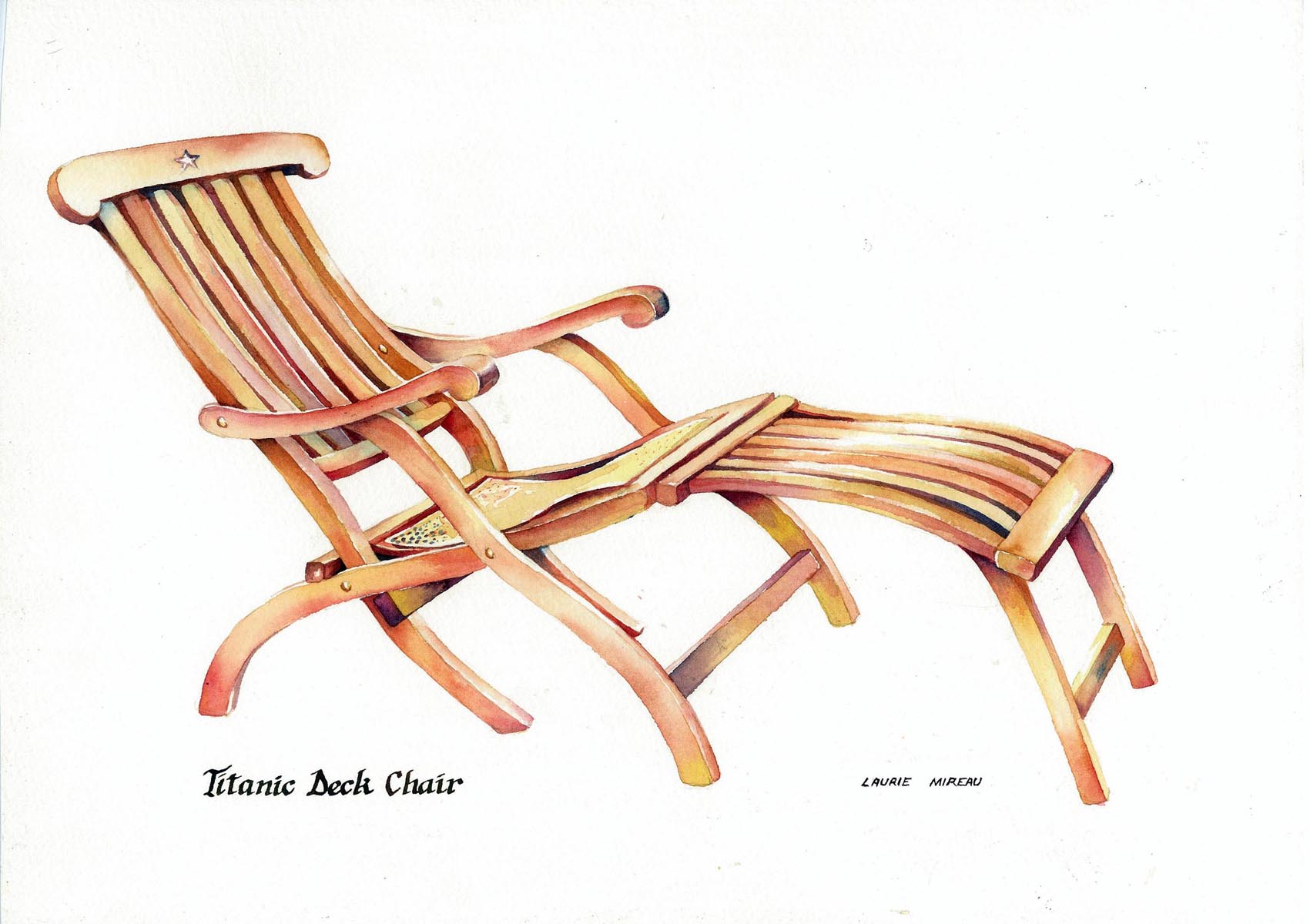
Titanic Deck Chair by Laurie Mireau.

Our little hometown city of Halifax Nova Scotia is marking the 100th anniversary of the sinking of the Titanic this weekend because Halifax, Nova Scotia is home to the graves of more Titanic victims than any other site in the world.

We love our city for the little gem that it is — and promise to write a guide to visiting it some time before the summer tourist season starts.  there is much to lure the discerning traveler and we do so love to play tourist in our own city from time to time.  Today, however, we thought we’d share with you a remembrance.

On our office wall just to the left of the desk hangs a beautiful watercolor that captured Patty one day when she saw it in a brochure for a local artist.  Finding Laurie Mireau in her Halifax studio, Patty was delighted to find that she still had the original of her painting of a deck chair from the Titanic, one of which is housed in the Maritime Museum of the Atlantic.

For us, the image is evocative of so many wonderful hours spent on ships at sea.  Hope you enjoy it as much as we do.  Laurie still has prints!

Five tips for finding your perfect, private, personalized, dream tour

We all have our obsessions.  Obviously, travel is one of ours, and along with that goes our obsession with personalizing our holidays.  Gone are the days of pre-arranged group shore excursions from cruise ships, and gone are the days of European bus tours with 42 other well-intentioned travelers for us (but we did have a wonderful time all those years ago on a whirlwind tour of Europe with a ten-year-old  – maybe we’ll tell you about it sometime!).

In our quest for personalization, we’re becoming experts on finding tour operators who specialize in bespoke experiences, and finding those tour companies online – a tricky and anxiety-inducing prospect as you lighten your wallet by a considerable sum before even setting foot in the country to which you are traveling.  For what it’s worth, then, we offer you our five tips for finding that perfect (for you), private, personalized dream tour.  First, the story of how we discovered these tips.

It all started a few months before when we began our search for a bespoke tour of the countryside outside Paris.  That search led us to À Paris Travel and a wonderful woman named Sue Lillie.  With considerable trepidation, we had started an online search for tour companies specializing in European travel, and soon found that there were too many to wade through with any degree of certainty about their quality.  So we narrowed our search to specialists in visiting France and stumbled on this wonderful company.  But we didn’t know that it would be wonderful at that time.

We decided that we’d focus on one of our obsessions – champagne – and more specifically in Patty’s case Veuve Clicquot champagne.  This led us to create a tour of the champagne district that would include a visit to the Veuve caves and a champagne tasting or two.  Before we were willing to pay the complete upfront amount, however, rather than conducting all of the transactions through email and the web site, we decided that a chat with the proprietor might put our minds at ease.  And so it did.  After a very pleasant conversation with US-based Lille (late of Montreal as it turned out), we felt quite comfortable paying in advance for the tour (which is required for most of these companies).  Then all we had to do was hope that a car and driver showed up on the appointed day at the appointed time.

Moet & Chandon in Epernay, France.

Early one gray morning in Paris we made our way to the front door of our hotel on the Champs Elysees to find Pascale leaning against his car awaiting our arrival.  And so we were off.

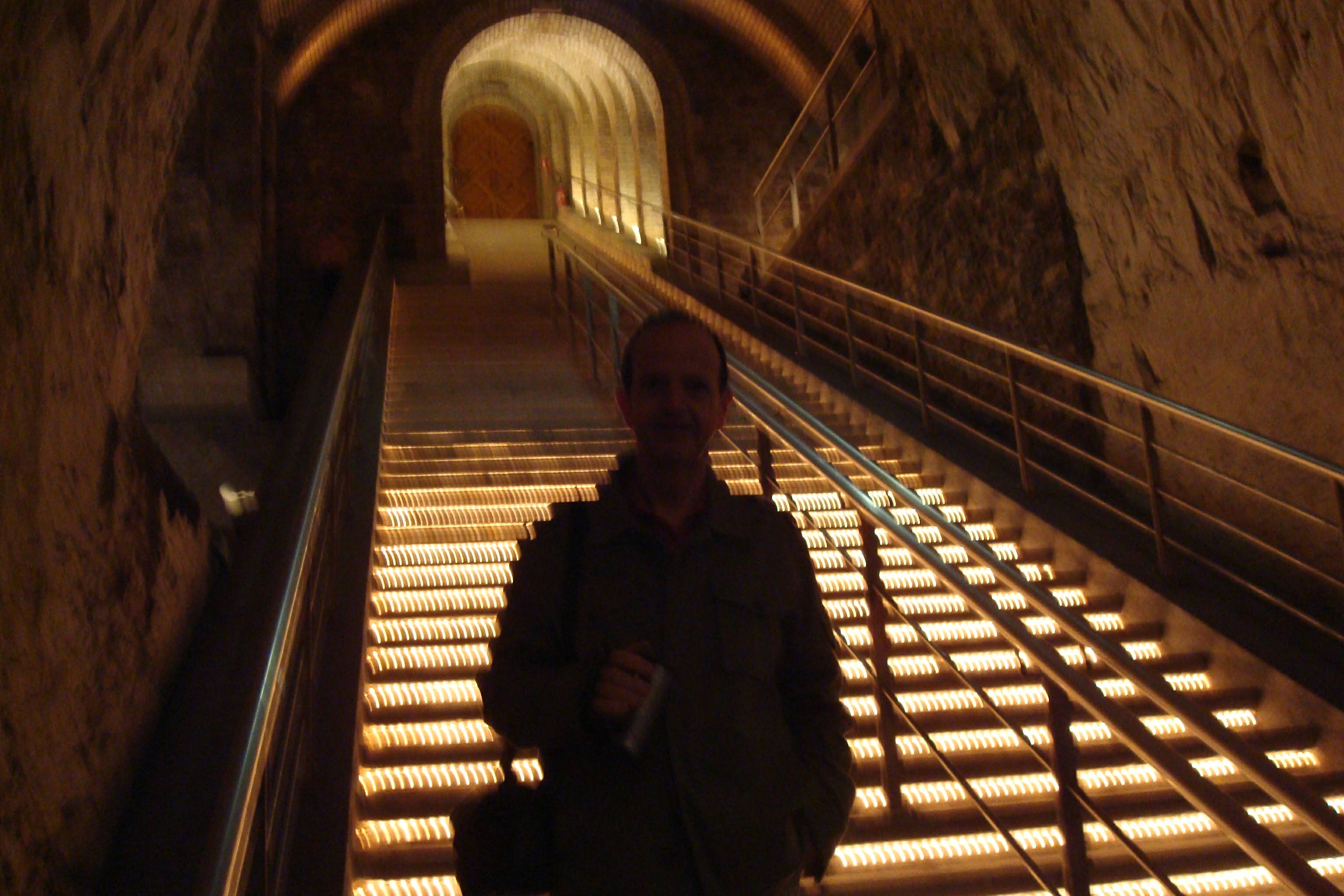
After a few brief questions about our interests, Pascale was quite sure he know just where to take us.  He’d take us to one champagne house, and then make arrangements for the other.  First, we’d visit Épernay where we would take a tour and tasting at the venerable Moet & Chandon, and then we’d venture to Reims, the largest city in the Champagne district and home to the Veuve caves.  Between the two, Pascale would drop us off at a favorite lunch spot where we’d join the locals for a bite to eat.

Patty at the champagne-tasting bar at Veuve Clicquot in Reims, France.

With just the three of us on board, we had all the freedom that a group tour just doesn’t offer.  The itinerary was ours alone and if we decided to veer off course at any point during the day, we could.  It was another of those days that you mark down in your memory as ‘perfect.’  In fact, it was so perfect that we relaxed a bit about the second tour we had booked during that trip (yes, we took a chance and booked two).  When tiny Caroline picked us up in her massive Mercedes in Villefranche on the French Riviera two weeks later, we knew that we were in for the time of our lives thanks to À Paris Travel and our willingness to take a risk.

Tip # 1: Be specific about exactly where you want the tour to take you.

We were quite clear that we wanted to visit Champagne, rather than simply saying that we’d like to take a day trip out of Paris which is the thought we had initially.

Tip #2: Decide what kind of experiences you’d like (follow your obsessions for example), and then keep an open mind.

We had other ideas when Pascale picked us up that morning, but other than the visit to Veuve, we were open-minded and let him guide us.  These kinds of open-minded approaches have led us to many wonderful experiences over the years.  And these guides are truly wonderful resources.  Use them!

Tip #3: Do your online research carefully and consider it to be part of the experience.

This is so important.  You need to do a lot of research, and you should consider not thinking of it as work; rather you might see it as part of the learning experience that travel ought to be.  We actually consider research prior to a trip a part of the trip resulting in a much longer experience than the week or three that are actually away.

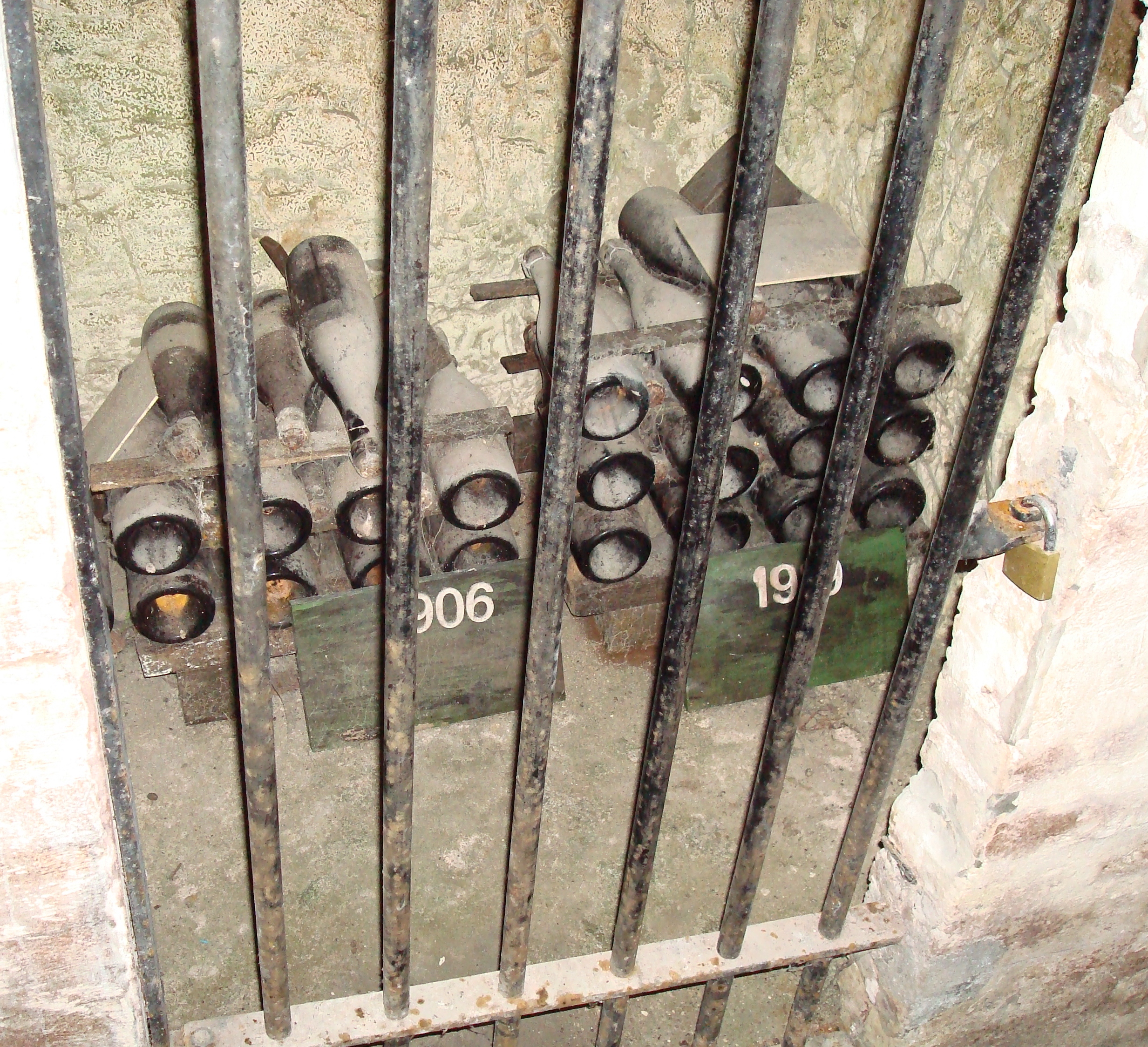
Champagne, vintage 1906, in the caves.

Tip #4: Do your due diligence.

For us that means that as often as possible, getting these tour operators on the telephone.  Even if it’s as simple as booking a limo drive from a cruise terminal, try to speak to someone in person once you’ve gathered all the information you can from the web.  You can learn a lot by that more personal contact.  If you have a gut feeling that this isn’t for you, you are very likely right.  Sue Lillie put us very much at ease as she told us about how her company had developed and her own passion for French travel.

You can also use online travel forums such as TripAdvisor (we’re contributors to this one), but remember that everyone is different.  Read the contributors’ pieces carefully and note the outliers – in other words, is it the only one that had a problem with the tour operator, or the only one that didn’t.  In either case, that one might not provide you with as helpful information as you might think.  Also, read reviews to see if they are specific, or if they are just subjective assessments (e.g. It was wonderful! Terrible!  etc. without concrete descriptions of exactly what made it so wonderful or terrible letting the reader then decide.).  In the end, a traveler review on a site such as TripAdvisor is based largely on the contributor’s expectations going in.  If we were to review some of the hotels that others find wonderful, we’d find them barely acceptable for a variety of reasons all based on what we’re looking for.

Tip #5: Make your decision, pay your money, and don’t look back.

Don’t second guess yourself.  After you make a decision, go with it.  File away other interesting information about other tour companies for the future, but don’t keep comparing what one might have offered.  You’ve made a decision, and it is very likely that if you did your homework, it will be the right one for you.

If you’ve hit on a truly terrific one, perhaps you’ll do what we did and book again with that tour operator.  We’d love to know how people make out with personalized tours.  If you have five minutes, come along with us as we follow our obsession with Veuve Clicquot from the caves in France to the Veuve bar aboard the Queen Mary 2.

Lessons we wish more airlines would learn: Our Hawaiian Airlines experience

In February we headed out on our annual pilgrimage somewhere south to avoid a few weeks of nasty Canadian weather.  Usually, it’s a simple hop to Toronto and then onward to – well, just about anywhere “down south” as winter-weary Canadians like to say.  This year, our four weeks away found us on no less than ten – yes ten—airplane segments on three different airlines.  Needless to say, there is going to be a certain amount of comparing going on.

Soaring over the Napali coast.

We began our trip on our trusty Air Canada to whom we are quite loyal.  There is much for a discerning traveler to gain from being loyal.  Travel blogger and co-founder of airfare-prediction site FlightCaster Evan Konwiser (who knows more about airline loyalty programs than we ever will) offers five golden rules for air travels that include, among others, never travel anywhere without earning miles of one sort or another and focus on one airline at a time (you can read the rest of the rules at The Golden Rules of Loyalty Programs, and you should!).  We agree and have, indeed, gained elite status giving us some of the perks that make comfortable flying less of an oxymoron.  However, it doesn’t always work out that you can fly on your favorite – or even on one of its alliance members.

Air Canada belongs to the Star Alliance so when we’re connecting to places where AC doesn’t fly, we usually book a Star Alliance partner (then we can still earn loyalty miles).  This year, that meant flying on United Airlines from LA to Honolulu since we were stopping in LA for a few days enroute.  Oh dear, when Dorothy realized she wasn’t in Kansas anymore, she was predicting how an Air Canada frequent flyer would feel when faced with what passes for first class (yes, that’s what our ticket said) on this partner airline.

Since we are among the older (one boomer and one beyond) members of the population, we have no issue with older workers.  However, when flight attendants look like they should be lounging poolside at a retirement village in Florida, and have to turn sideways to make it up the aisles, we do begin to wonder how efficiently they would be able to move when faced with an emergency.  And what’s with all that scowling at passengers?  Then we had a great laugh when we saw the movie screen at the front of the cabin with its one movie on offer – we haven’t seen one of those since—well, since the last time we flew on an American-based airline a few years ago on our way to Puerto Rico (where Air Canada inconveniently does not fly).  A word of advice to our dear American friends: You really need to take a lesson from your partners north of the 49th parallel and in Europe (see Lufthansa).  Air Canada customers may complain as much as the rest of the flying world, but it’s clear to us most of the whiners haven’t traveled on American-based airlines lately.

We did, however, get safely to our destination relatively on time and with our luggage.  Who can reasonably ask for more these days?  Well, we can now that we’re-experienced Hawaiian Airlines – so our theory about American-based airlines doesn’t really hold up.

Our first experience with Hawaiian was some 10 years ago when we first ventured to Hawaii.  On our trip between Honolulu and Maui, we were booked on Hawaiian.  Our most vigorous memory of that event was the panic that preceded boarding: there were no assigned seats and the queuing began very early with a mad dash when the flight was called.  Our heads were spinning by the time we finally got on board and found remaining seats.  Needless to say that when we found ourselves booked on Hawaiian again, we were concerned.  We could have saved ourselves needless consternation because Hawaiian Airlines is what we would call a flawless operation from beginning to end – and we took four of their flights in a two-week period.

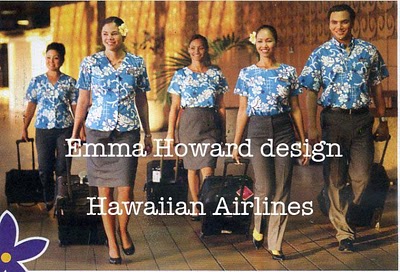
In 2012 Hawaiian Airlines commissioned textile designer Emma Howard to design the Hawaiian pattern for the new uniforms. They are wonderful.

Where does Hawaiian Airlines find its people?  To a person, they were flawlessly personable and helpful.  When we arrived at the airport in Honolulu to catch our flight to Kaua’i we were hopelessly confused at the baggage drop-off.  And we were not alone.  The system did seem a bit foreign, but helpful agents were able to get us in the right line, and now we know how to navigate their system.  (Let’s face it, the variations in policies regarding check-in and baggage drop off among airlines throughout the world is mind-boggling.  It would be nice if they could get it together.  This is a tall order, we fear though, since even the security screening rules differ wildly from one airport to another even in the same country – shoes on, shoes off, cases in a bin, cases not in a bin, sweaters on, sweaters off, aahhh…you understand and we’re digressing).

We were flying first-class on these flights, but since the distances are short and many of the airports small (not the case in Honolulu) we did not expect many amenities.  We were surprised to learn that there are indeed first-class lounges in all the airports and more than one in Honolulu.  Decorated in Hawaiian motifs, the lounges don’t offer much in the line of food or drink – not necessary in these cases – but they are quiet, air-conditioned oases.

We heard a number of announcements indicating that Hawaiian Airlines was pleased to offer their customers advanced seat selection which suggested to us that the change was fairly recent.  Wonderful!  Actually, the reason we booked first class was because of our fear of the panic for seats as a result of our initial experience.  We needn’t have worried.

Once on board, the flight attendants were happy, helpful and fitted with delightful Hawaiian-inspired uniforms (with prints designed by Hawaiian textile artist Emma Howard) that made us smile.  On these short flights, they even managed to get us a drink and a snack – Mai Tai’s were our drink of choice!

The people were wonderful—but perhaps even more impressive was the efficiency of this airline.  With a mere 30 minutes turn-around time on each occasion, they managed to get the passengers and their luggage off the planes, the embarking passengers and luggage on and get away on time, all without seeming rushed.  The morning we flew back from the Big Island to Honolulu on our way home, there had been a computer glitch earlier in the day that had caused some delays.  Our flight arrived in Kona 10 minutes late, and with that planned 30 minute-turn-around we fully expected to be late, a situation that might have resulted in rushed connections.  Not to fear, though!  They still managed to get luggage and passengers off and on, and take off on time – a turnaround time of 21 minutes!

You might be thinking that we’re talking about a little turbo-prop plane with few passengers aboard, but they fly 717’s on these routes.  These full flights had 123 passengers on board and they still managed it.  We watched the baggage handlers efficiently moving luggage on and off the planes, and it seems to us that employees from other airlines could learn a thing or two.  In all our years of travel we have never experienced such fast arrival of our luggage – and that goes for small airports throughout the Caribbean.

Despite the fact that Hawaiian Airlines is not a member of the Star Alliance and thus we did not accumulate any frequent flyer points for the four flights we took, we enjoyed every minute of it, will do it again (may try one of their trans-Pacific flights next time) and would recommend them to anyone!

* Photo sources: http://mauinow.com/2011/10/10/hawaiian-airlines-adds-fifth-new-airbus/;

http://4.bp.blogspot.com/_nXFbQ8i7KNE/S8YGptkRNQI/AAAAAAAAACc/UT_kCoH5KjM/s400/Hawaiian