Comfortable air travel: Not an oxymoron

Noise-cancelling earphones = Increased air travel comfort

Oh how flying has changed from the days of the smiling Pan Am stewardesses [sic] who served real food on real china even to economy passengers who could actually shift their legs in comfort.  At least, that’s how it looks when we watch the new piece of television nostalgia that is this season’s Pan Am.  But it’s the 21st century, and much has changed.  That said, as we put the finishing touches on arrangements for our winter holiday to Hawaii (that’s after we return from our Christmas in the south of France – more about that to  come), it occurs to us that we’ve learned a thing or two about discernment in air travel these days.

We’ve been thinking about all the things that we’ve learned to maximize our comfort when traveling by air so that the journey is part of the experience rather than being that-which-must-be-endured to get to the good stuff.  It’s also worth considering whether add-ons offered by the airlines are worth it for you and might actually contribute to a near-luxurious experience.

Here are our four rules for discerning air travel:

Rule #1: Be very judicious about your seat selection. 

Our obsession in this realm began some years ago when we flew to Seattle to meet our son who was doing a summer exchange program with the Pacific Northwest Ballet school.  We decided to meet him, drive down the coast to San Francisco and fly home to the east coast from there.  We had little choice at the point of decision but to book three seats in economy on the “red-eye” after which we fell out of the plane, kissing the ground and vowing that we’d never travel like that again.  So, if you can afford business class on any flight over three hours, just do it (or don’t complain).  If you can’t afford business class (and remember that the airplanes run seat sales on business class during low business travel seasons such as Christmas), the discerning traveler can still be judicious about seat selection.

Find the rest of this at http://www.seatguru.com

The most important thing you need to do is to visit www.seatguru.com.  First, as you are making your booking (even if you are using a travel agent, do this first), look at the aircraft type for the flight you are interested in.  Then go to Seartguru and find the airline and the aircraft. Look at the cabin configuration and their assessment of the seat (for example, if there is no bin space above this seat, it will tell you; if there is a bit of extra leg room, it will tell you; if the seat does not recline because it is in front of an exit row, it will tell you etc.)

If you are flying in economy on an airline that offers premium seats such as those at bulkheads and on exit rows, if your flight is long, you will find that there is great value to spending the extra cash.

Rule #2: Never arrive at an airport without your seat already selected (and preferably at time of booking).

Oh the comfort of the Air Canada Executive-first seats

As we were planning the upcoming Hawaii adventure, we were reminded of a previous trip when we used this inter-island airline.  At that time, there was no advance seat selection at all.  That meant that before boarding was called, people began to line up – a situation that we did not understand.  We were to find out  quickly.  When boarding was finally called, the crush to get onboard was frightening.  No one had a seat and everyone wanted to be first to get a “good” one.  This year, we’re booked on first class seats on Hawaiian Airlines between islands to avoid this particular nightmare.

Rule #3: Never get on an airplane without noise-cancelling earphones.

No exceptions.  Invest in a set of noise-cancelling earphones, attach them to your music source (our choice is an iPhone; our earphone choice is Bose) and you’ll never care again if there is a wailing infant on the plane. Of course you can’t use them during take-off and landing, but they will be a godsend during the flight and they can attach to the plane’s entertainment system if you’d like to watch a movie.

We learned this lesson on a flight from Barcelona to Paris a couple of years ago (Iberian Airlines if you must know).  When we boarded the plane (on which we had been unable to get anything other than two center seats in economy) we found ourselves surrounded by a large group of people from China.  We could only conclude that they had not received the memo about being quiet on airplanes (forgive us for this expectation: we’re Canadians and on Air Canada, things tend to be quiet unless there’s a wailing infant on board; see above).  These people seemed to think that talking across three or four rows was business as usual.  It was the longest two hours of our lives.

Rule #3: Invest in the lounge-access card for your airline of choice.

If you typically fly on one airline much more than another (which you should since there are many perks to being a frequent flyer) and you are not usually paying for business class flights, the investment in the access card will greatly improve your comfort when flying.  This is particularly evident when your flight is delayed.  It is another add-on that is worth the investment.

Rule #4: Never get on an airplane without some food on your person.

…and this holds true even if you’re flying first or business class.  We always take protein bars because they are non-messy, easy to carry and can be carried over from one trip to another if they are not used (until they reach their best-before date of course).  The importance of this habit was brought home to us on a flight from Toronto to Antigua one winter.  The plane was unable to land in Antigua (evidently they didn’t have a guidance system for fog), so we ended up spending the first night of our Antigua vacation in Barbados.  The next morning, we were up very early so that the plane could take us to Antigua as planned.  We arrived early at the airport via airline transport without breakfast (too early at the place we stayed) to find that the only sustenance available was coffee.  We had no idea when our next meal would be so we broke out the protein bars and had a pleasant wait until the plane finally boarded.  The issue of extra food becomes especially important when a flight is delayed on the ground.

Our son flew from JFK to Toronto earlier this year and the flight was delayed two hours on the tarmac!  He had no food, and since the flight was so short, there was not food on board.  He was mighty hungry when he finally arrived at his destination.

So, there are our four rules that we never ignore – and our airplane trips are (almost) fun.

Good things come in small packages: A small-ship cruise

A picture is worth a thousand words - The Silver Cloud (on the right!)

For many people, bigger is better.  For us discerning travelers…not so much.  When the ship Oasis of the Seas launched in 2009, we took one look at its specs (close to 6000 passengers) and knew immediately it wasn’t for us.  The largest ship we’d been on at that time was just slightly over 2000 passengers, and we knew that was quite large enough.  But we wanted to go smaller.  So we looked to the self-described “six-star” experience.

It’s wonderful to be at that point in our lives (nudging ever closer to retirement and yet still with significant cash flow) so that we can travel in a way that allows us to be a bit more discerning than we used to be – because, self-described or not, the so-called six-star cruise lines cost.  And for us, there is one place where bigger is better when it comes to getting on a cruise ship; that place is the size of the stateroom.

On the occasion of our twentieth wedding anniversary some years ago, we decided to treat ourselves to a Royal Suite on a Celebrity cruise ship and we’ve never been able to go back to a smaller stateroom.  So, we are looking for value when we choose an experience.  In the case of moving to smaller ships, we first tried Regent – first the Navigator (490 passengers) and then the Mariner (700 passengers)[1] – then ended up earlier this year on a Silversea ship, the Silver Cloud with all of 296 passengers.  What an experience that was!  Even if you can’t afford a Silversea cruise, or a Silver suite on board, come along with us and we’ll tell you what it’s like.

Art in the suite dining room

We boarded the Silver Cloud in Bridgetown, Barbados at the cruise terminal.  We were greeted not by the usual line-ups and booths that face you when you go aboard a larger ship in places like Fort Lauderdale; rather there was a table with three of the ship’s personnel to greet us with our documents and a wave us to the pier.  Once on board, with a glass of champagne in hand, we had our ID photos taken and were whisked to our suite.

What made the ship so different than previous experiences was that you could stand in the bar at one end of the ship and look down its one corridor and see to the other end.  Then, as you walked along the corridors past occasionally open doors of suites (every stateroom aboard is at least a small suite) and see out both sides of the ship: there are no interior cabins; everyone has an outside suite and some 90% have verandahs.

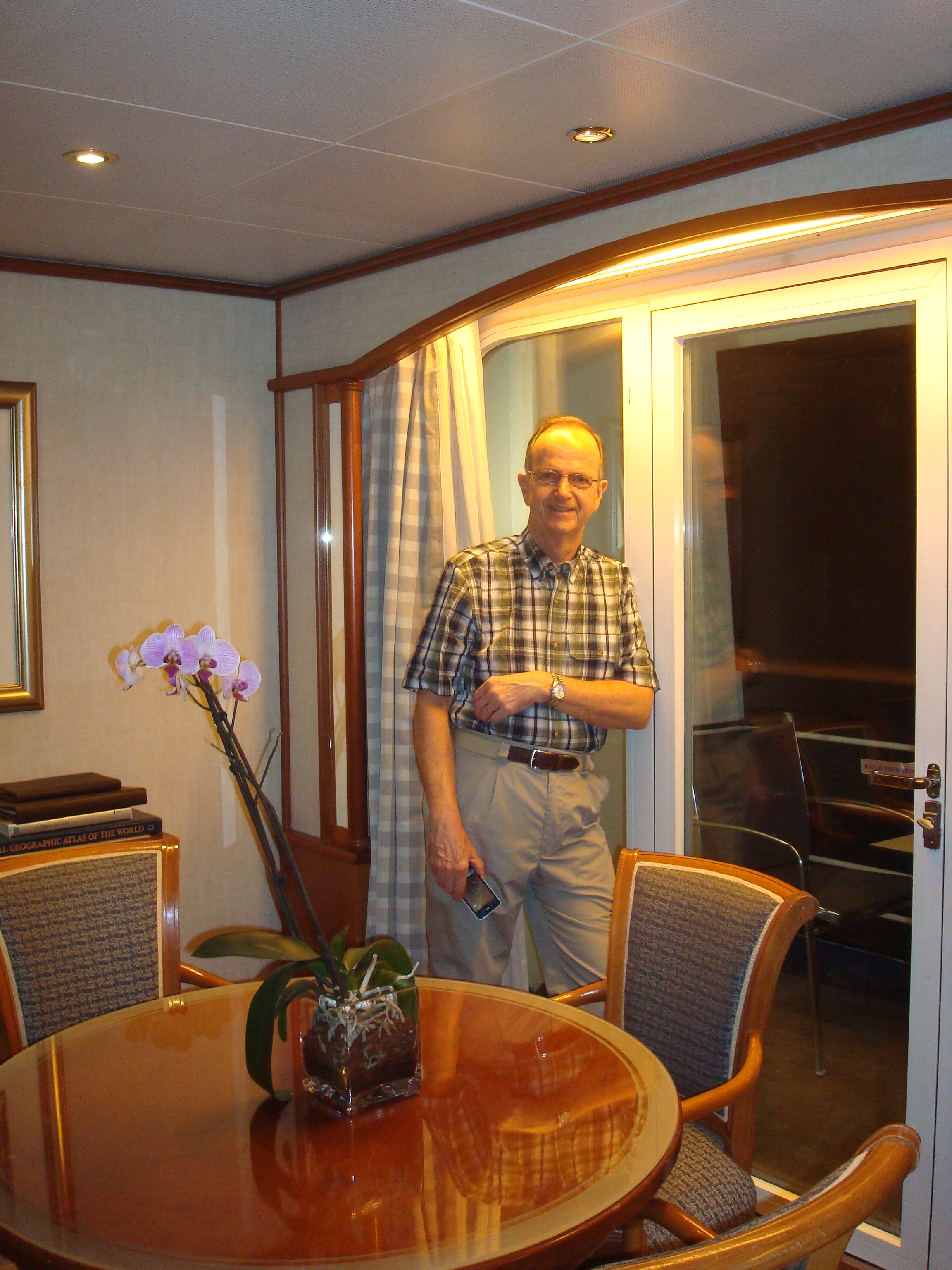
Patty in the suite living room

The ship’s itinerary took us to several islands that we had never visited before either as an island vacation or as a cruise ship port.  These included Dominica, Bequia and St. Bart’s.  Some islands just don’t have the capability for one reason or another, to host the larger ships, so smaller is better when it comes to accessing them as ports.

We prefer just the two of us for dining companions on any given cruise ship.  In fact, when ships have set dinner times and tables, if we can’t be guaranteed a table for two, we won’t book.  We’ve been burned in the past by having to spend a meal or two in the company of loud wind-bags who like to hear themselves talk – not our idea of a relaxing meal.  On these small ships you just arrive at the dining room any time during dining hours and ask to be seated.  In our case, our requests each evening for a table-for-two were never a problem (unlike a previous experience on a Regent ship when the maître d’ simply could not seem to understand precisely what a table-for-two meant).  Despite our  preference for ‘twosomeness’ in dining, the ship is small enough that you would have to stay in your suite the entire cruise to not come in contact with just about everyone on board some time during the 10 days.  The amazing thing was that we found ourselves in the company of some 250 like-minded people.  These were people who could afford to travel well, but who were looking for an experience that assured them they had spent their money well.  They were not disappointed in this experience, nor were we.

One aspect of travel aboard these six-star ships a traveler needs to know is that people dress.  Some of the lines (Regent for example) have really moved away from truly formal evenings, however, every night on the Silver Cloud was like a cocktail party with cocktail attire expected – and you would certainly stick out if you chose not to dress up a bit.

Our invitation to dine with the Captain of the Silver Cloud

Of course, the food was wonderful and these are all-inclusive experiences.  Not once does a bar tender ask you to sign a bill.  There is no passing over your room key for anything to be added to your bill (except spa services and if you choose wines off the sommelier’s premium list).  Wine, drinks, and gratuities – they are all included in the price.

The entertainment was fairly low-key and yet there was always something to keep us amused.  We would not, however, like to have too many days at sea on such a small ship.  This kind of a cruise where there are five or six lovely ports to explore is the ideal way in our view to experience all the perks of small-ship cruising.

We ended up sharing our van and driver with several passengers from another larger cruise ship who were stranded at a beach on the island of St. Kitts.  When they asked us which ship we were from and we mentioned the Silver Cloud, one of them asked us what it was like on board such a small ship.  “I  heard that everything is included and you have a butler,” he said.  We nodded.  He sighed.  “I’m going on one of those someday,” he said.  “It looks like a private yacht.”  Couldn’t have said it better ourselves!

Bequia
Bequia

One perfect day – on the Med

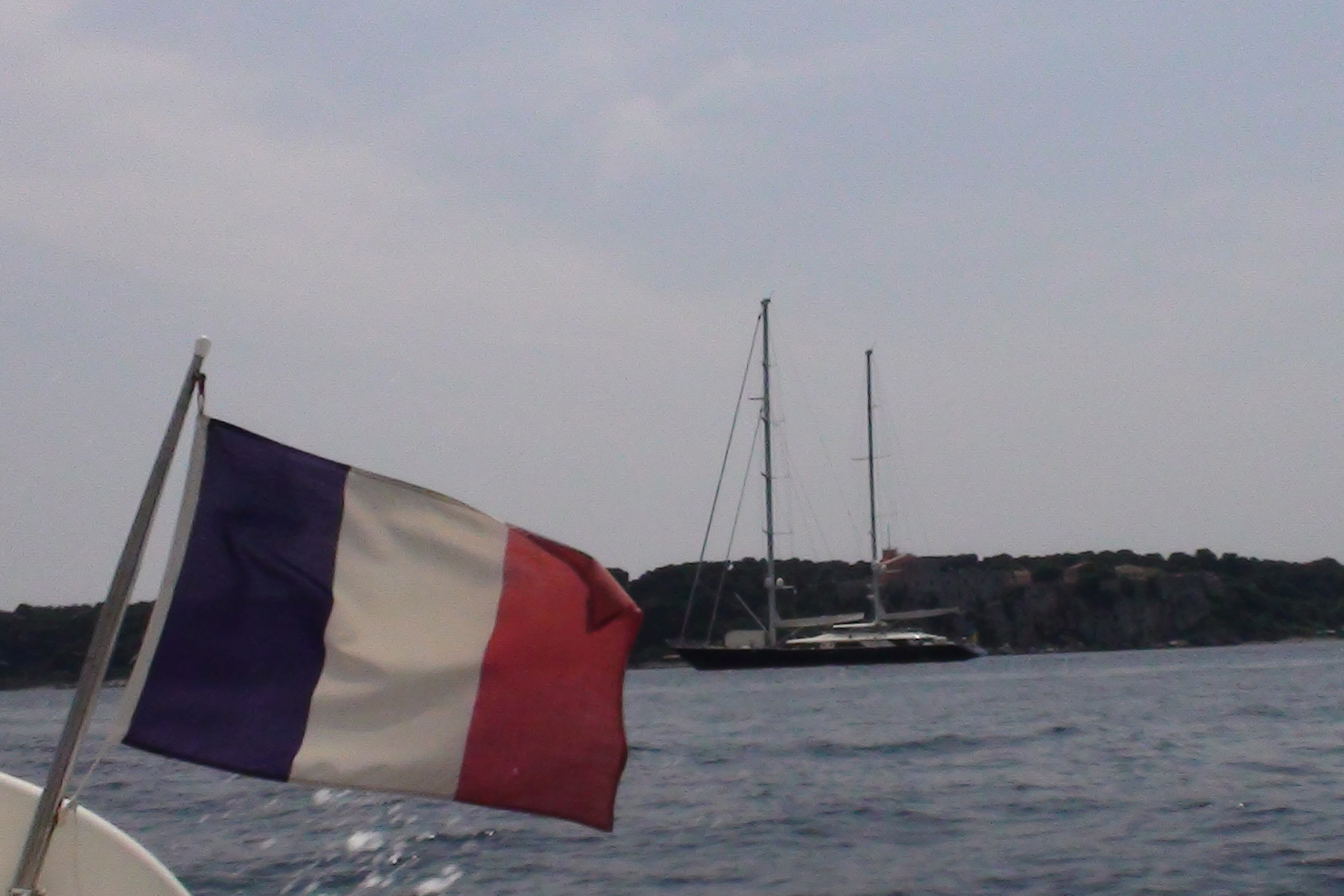
The stern view from the perfect perch

I was sitting in our charter boat, sipping a glass of champagne and trying to see if I could bottle up the memory of this one perfect day so that I could take it out once in a while and relive it when I needed to.  Being able to do that takes really being in the moment – and a great still and video camera doesn’t hurt!

So, how did we get there that day?  It was last July and we were visiting our son in the south of France (we’ve often said that the main purpose of having children is for their entertainment value – and we have that in spades with our son who is a dancer with Les Ballets do Monte Carlo – yes, that Monte Carlo, Monaco).

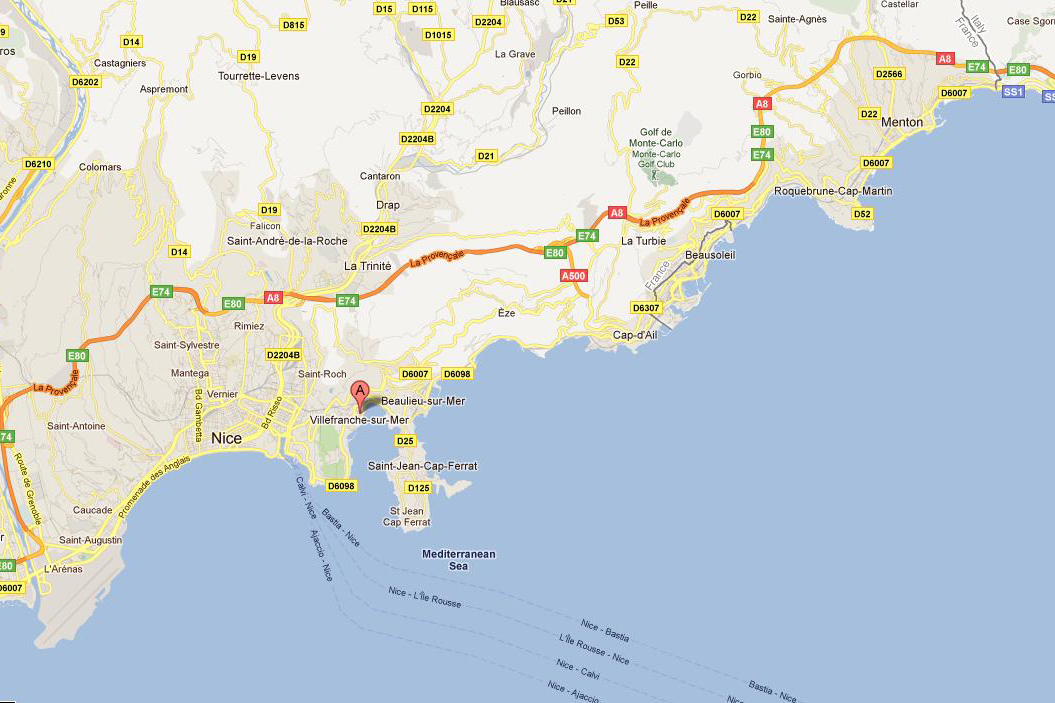
We had seen along that part of the Riviera from Roquebrune just bordering Monaco to the east, as far as Cannes in the west as we visited from time to time on foot and by car.  Now, we wanted to see it all from the water.  So, as any discerning travelers would do, we started our research online.  We usually find that asking our friends is a recipe for disaster – many of them, as well-heeled as they might be – are unwilling to pay a bit more to get a bit more.  We are not.

To say that there are a lot of boat charter companies operating on the French Riviera would be a considerable understatement.  We narrowed the search down and emailed several.  The most personalized service, with the most interesting possibilities for planning our perfect day came from Boatbookings.com.  They were efficient and knew exactly how to provide us with what we were looking for (and they all speak English which made it so much easier!).  We settled on a 35-foot cruiser with a captain and catered lunch for an eight-hour cruise.

A glimpse of Monte Carlo -- from the harbor.

The young captain picked us up at the pier in Cap d’Ail where we always stay, and off we went for the day.  We stopped to anchor twice during the day – once for swimming off the boat, and once for our picnic lunch on board.  Of course, part of the perfection of the day was a result of the stellar weather – it could not have been nicer – or more luxurious.

In our continuing search for those luxurious experiences, this is one that will go down in our books as worth every penny (and euro) we spent.  It’s an experience that we’ll remember forever.

The value of luxury: The “six-star” experience

For several years now, we’ve been grappling with the question of what constitutes luxury.  As discerning travelers, we are interested more in refinement than luxury per se since most people seem to think if something is expensive, it constitutes luxury.  But that isn’t necessarily so.

A couple of years ago, we embarked on our first “six-star” (their marketing literature said it – we didn’t) luxury cruise.  While on board, we thought it might be a good opportunity to ask a few of these very well-heeled travelers what constitutes luxury for them.  Not one of those we asked mentioned anything about expensive items; rather they were focused on  experiences that for them were luxurious. For example, one of the women who could buy and sell the best of us, said that for her, luxury would be having someone to wash her hair for her every day.  Another said that to have fresh sheets on her bed every day is a luxury.  Others had similar opinions.  What all of these had in common was sensuality, if you must know.   More importantly it gave us a notion of what luxury means these days: a luxurious  experience.  In that spirit, we decided to embark on a journey of finding those luxurious experiences.

The Ritz Carlton at Half Moon Bay in California is set on a rugged bluff overlooking the Pacific.

A September wedding in San Francisco this year inspired us to take a few days afterwards and head down the coast for a road trip.  Our first stop was the Ritz Carlton at Half Moon Bay.

This hotel is a quick hop from San Francisco and we decided that its ocean front location and rugged coastline beauty might make it worth the splurge.  It was (sort of).

There is no doubt that the hotel is beautiful but we’ve been to many beautiful hotels.  What would make this a luxurious experience for us?

Would it be the resort grounds? They are very nice, but no nicer than any other nice resort has to offer in a lower price range. How about the restaurants?  The restaurants on the property have wonderful ocean views and the food is well-prepared and served – but perhaps not earth-shattering.  The rooms?  The room was beautifully appointed but no more than what we come to expect.  The bathroom started veer into the luxurious – marble from top to bottom, a spacious walk-in shower, a fabulous Jacuzzi.  Rooms on the ground floor have fire pits which are nice, and for some might constitute a luxurious experience.

For us, the thing that made this a luxurious experience wasn’t the bricks and mortar, though.  The most outstanding feature of this Ritz Carlton property is their staff.   Every single one of them we encountered from the outdoor bar staff to the valets who parked our car were terrifically well trained and made it their business to learn our names.  It was one of those little touches that makes you feel special – and if an experience doesn’t make you feel special, then in our books it isn’t luxury.  The Ritz Carlton motto is “Ladies and gentlemen serving ladies and gentlemen”, and this experience drove home to us that it is more than a motto: it is a way of life for their staff.  For example, it was also such a nice touch to find the valets had cleaned the windshield of our rental vehicle, and there were two bottles of water already in the cup holders awaiting us when we got in the next morning to continue our road trip down the California coast.

The experience made us wonder, though, about the “value” of this luxury hotel.  We concluded that its price tag, exactly twice what we had paid a night at the Stanford Court (Marriott Renaissance property) in downtown San Francisco the night before, was perhaps not worth it.  Marriott staff around the world are well-schooled in hosptiality as well.  All we can say is that our gut impression of the relative value is that the Ritz Carlton name may imply luxury; you don’t necessarily have to pay this much for a luxurious experience.