Dressing for dinner: An eye on cruise line dress codes

The Discerning Travelers strike a pose on board a Celebrity cruise ship on a designated formal night.

Some people like a kind of laid-back beach holiday that finds them schlepping around in a T-shirt and shorts with a cold brew always at hand.  Others have to sky-dive or parasail or bungee jump every day.  We are travelers of a different stripe.  We like to drink great wine, walk for miles and miles exploring new and now-familiar cities, have new experiences, sample a new cocktail or two – and dress for dinner.

There’s something just a bit sad about how people “dine out” these days.  Just recently, we read a blog where the writer suggested that dinner is really only about the food.  Well, we respectfully disagree.  Dinner is about dining, and dining refers to a whole lot more than eating.  You can eat anywhere, including your couch.  Discerning travelers are also discerning diners.  We are interested in the whole experience.  Where we eat and the surroundings are as important as the food, and part of those surroundings focus on what you wear when you eat.  Cruises are a prime example of what, where and how one can eat.

The very first time we cruised, we were bemused by the vast number of people who chose to remain on deck in their bathing suits all day and most of the evening, leaving their deck chairs only long enough to load up their plates at the nearby buffet, returning to sit on the edge of the chair, face in their plates, chowing down through the pile of food.  (Presumably they then leave to use the facilities – but we are only guessing here).  Food for us is much more than eating, and dressing for dinner is one of the pleasures of both land and sea-based vacations.

This past weekend, we took some time to make a few decisions about what to pack for the upcoming vacation that will put us on land in Puerto Rico for a few days and then at sea  through the Caribbean, up to Bermuda and then farther up to New York.  Packing for a cruise has its special considerations as we peruse the various ‘dress codes’ that cruise lines use.

Cruise lines seem often to have a language of their own.  Every cruise line has in its FAQ’s a question that goes something like this:  What is the dress code on board?  The answer depends on the line, its brand and its target market.  Let’s look at a few.

Formal night on the Regent Seven Seas Navigator.

Some cruise lines have begun to distance themselves from the more formal evenings, which is a shame in a way, but we do recognize that there are people who don’t find it fun to get dressed up.  If, however, there is a dress code in the dining room, you’d do well to follow it, or risk the stink-eye from fellow cruisers, or worse, ejection from dinner to a more casual corner of the ship.  Some cruise lines actually refuse you entry to the dining room if you are not properly attired (God love Cunard) while others seem to turn a blind eye (although, rest assured, other passengers don’t and you’re being disrespectful of their experience).  So, if you don’t like to get dressed up, pick a different line!

Regent Seven Seas cruises that has played host to us on two vacations over the past three years is a six-star line that has gone to what they call “elegant casual” for every evening with “formal optional” nights on longer cruises.  On this kind of a cruise line, people do follow the dress code, and many cruisers who prefer the more laid-back approach of say NCL, might find the dress formal even on elegant casual nights.  Their dress code says, “Attire ranges from Casual to Formal Optional. Casual wear is appropriate for daytime onboard or ashore, and consists of resort-style outfits. Casual wear, including shorts and jeans, is not appropriate after 6:00 pm, with the exception of the final evening of the cruise.”[1]  The cruisers on Regent do take appropriateness seriously.

Patty and son, Ian, descend the central staircase on Cunard's Queen Mary 2.

Silversea, a line we have traveled on only once last winter, another six-star line, has this dress code: “Evening attire falls into three categories: casual, informal and formal. On casual evenings, open-neck shirts, slacks and sports outfits are appropriate. On informal evenings, women usually wear dresses or trouser suits; gentlemen wear jackets (tie optional). Appropriate formal evening wear for women is an evening gown or cocktail dress; men wear tuxedos, dinner jackets or dark suits. On formal nights, guests dining in La Terrazza may opt to wear casually elegant attire (dresses or trouser suits for women; jacket, tie optional for men).”[2]  Again, they take this seriously.

On Cunard last summer, formal meant formal.  Full-length formal gowns and tuxedos far outnumbered the cocktail dresses and dark suits on the Queen Mary 2, and anyone skulking around in shorts quickly departed (and were not welcome in the dining room in any case).

Next week we’ll be aboard the Celebrity Summit, our third trip on this line.  Our documents indicate that there are two formal nights on this eight night cruise and the rest are “smart casual & above” a category of dress that often baffles and leaves it open to serious interpretation.  In general, however, this means no T-shirts, jeans, shorts or flip-flops.  It means a summer dress or pants and fabulous top for women, and open-collared shirt with slacks and cool shoes for men.  A really cool, above-smart-casual man will wear a jacket as well.

Formal nights for us mean evening gown and tux.  Art always frowns when he has to pack his tux (he frowns only at the packing of it, not the wearing ), but this time he’s in luck. Celebrity has a formal-wear rental program and his tux with all the accoutrements (and he even ordered formal shoes) will be hanging in our suite when we open the closet door on Saturday afternoon.  And it will fit perfectly: we know this from past experience.  All it requires is for you to measure carefully and input the correct measurements when you pre-order online.  Patty, on the other hand, will schlep formal gowns (or in this case one formal gown with two different optional jackets for ease of packing).  A tip for formal gowns for cruises: when you’re shopping for one, always gauge its heft before you try it on.  If it’s heavy, don’t even take it into the dressing room.  Then if it passes the weight test, take a bunch in your hand and ball it up.  When you let it go, if it still has creases, leave it on the rack.  Remember, you’re not permitted an iron in your stateroom on a cruise ship.  The best you’ll be able to do is go to a communal laundry room to wait in line for an iron.  If it doesn’t pack well, don’t buy it.  Then find several different kinds of wraps – better yet jackets these days.  Wraps are cumbersome and usually look overly stuffy.
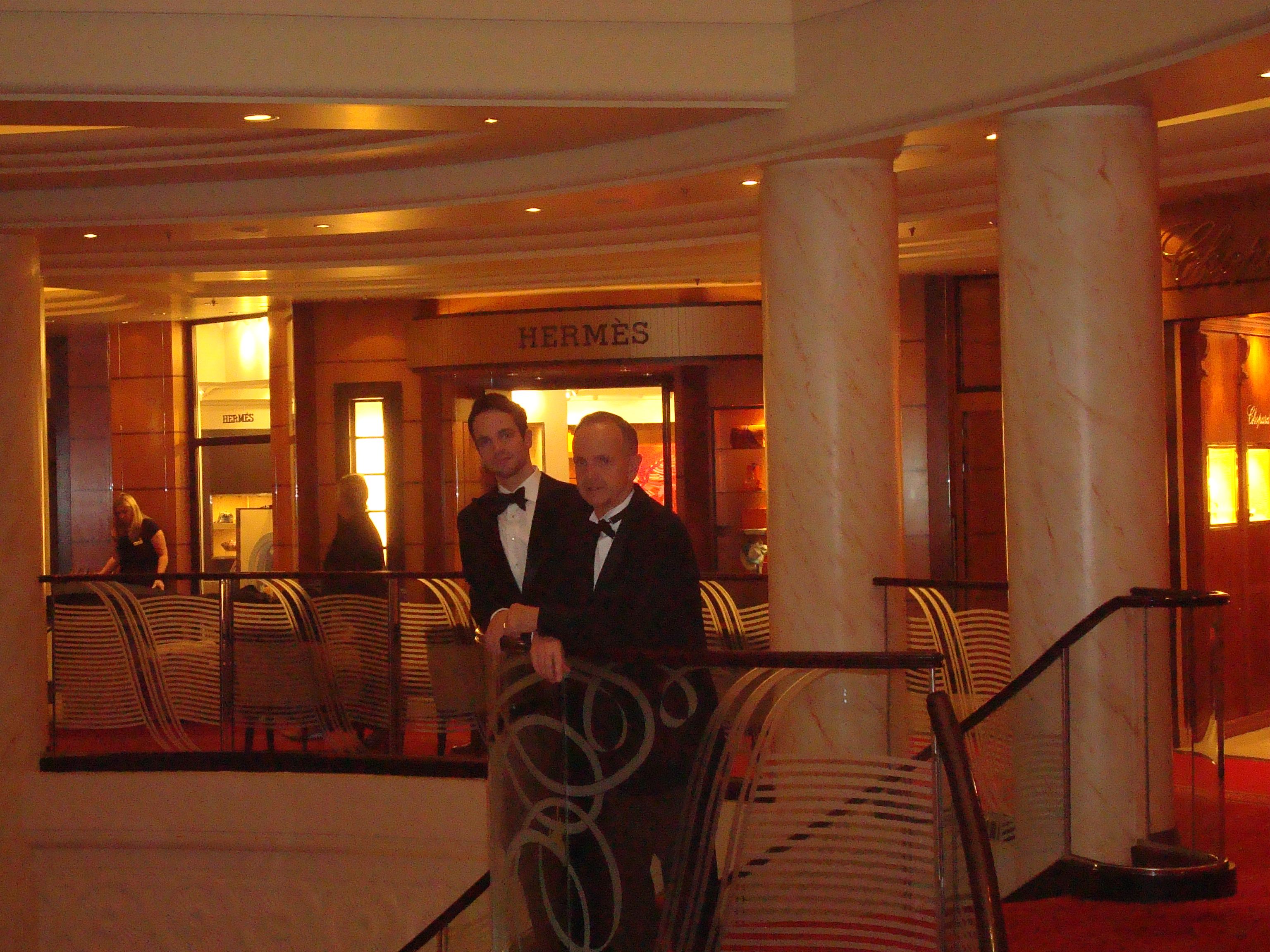
There's nothing better than the sight of a man in a tuxedo - unless it's two men in well-fitting tuxedos. Art & Ian onboard the Queen Mary 2.

The experience of dining in a wonderfully appointed dining room surrounded by people who have taken the time to look their very best for the evening is a vacation experience that everyone should have once in a while.

There's a little bit of "Gloria" in all of us!

A discerning guide to interpreting online reviews of restaurants & other things…

The tables at Gaylord's in Kauai are arranged around the inner courtyard of the plantation house under the porch awning. As the sun sets, the soft light of the torches begins to glow.

Call it social media, web 2.0, the inmates taking over asylum or whatever other terms (laudatory or derogatory: take your pick), but call it here to stay.   And less than a decade has passed since everything has changed for us discerning travelers when it comes to making travel decisions.  When we first started globe-trotting, we relied on two important sources of information: travel brochures and a trusty travel agent.  These days, although both of these are important (brochures that have morphed into glossy magazines because it feels so darn nice just to turn the pages in an evening with a glass of wine, and our travel agent, Angela because we rely on her for getting us into and out of complicated trips), there is such an array of other information that it boggles the mind.  So, why don’t we just ignore all those new sources of information?  Well, that would be just dumb.

But the question still remains: how do you wade through all of the information?  Our main concern is how to interpret the user-generated reviews; in other words, how do you discern the truth from reviews posted by fellow travelers?  Not easily as it turns out.  Here is our story.

Patty actually teaches social media to graduate students in communication studies at a local university.  So, in our case, we do need to keep up with what’s happening.  Over the past year or so, we’ve become regular reviewers on TripAdvisor, one of the largest (perhaps the largest at this stage) traveler-based review site for hotels, restaurants and travel experiences.  That usually means that we also use reviews posted by others to get a sense of location, hotels and restaurants.  The trouble is, after we’ve been to some of them and we go back to post our own reviews, we often see discrepancies that are not so much a function of differing points of view, rather they seem to be based on some reviewers not actually reviewing the right property at all!  Here is our case in point.

The entertainment at Gaylord's.

In February we headed out to Hawaii in search of some warmth and relaxation in Kauai and the big island.  While we were in Lihue on Kauai, we chatted up the concierge at the hotel to find dining options and decided to take a taxi to Gaylord’s.  Located on the ground floor of a wonderful period plantation house on the outskirts of Lihue, this restaurant is a real step back in time.  With top-notch service, wonderful food and evening entertainment in the open-air restaurant, the evening was memorable.  And so on our return home we decided to post a review of the spot on TripAdvisor.  As we usually do, we browsed other reviews before writing ours so as to add something that might have been overlooked by others.  Much to our surprise, we noted several reviews that said things like this:  “The show is stunning with beautiful music and stunning fire twirling. Food was buffet cafeteria style and not A+ quality…”  Huh?  Where were they?  They certainly didn’t dine at Gaylord’s.  However, they were on the property.

Be sure to visit the rest of the plantation house after dinner -- here is the great room.

At the Kilohana Plantation which is where Gaylord’s is located, there are luaus twice a week on the back lot.  In fact, the evening we were there was a luau going on, but other than the cars parked out front, the crowd at the buffet-style luau didn’t interfere in any way with our own experience.  However, this person who wrote the review (and this one was not the only one) certainly didn’t eat at Gaylord’s.  This suggested to us that there might be many other mistakes like this one.  Obviously, our review attempted to clear this up.  But it begs the question of how to interpret what you read.

Here are some of the things we’ve learned about interpreting travel advice on the web.

  • Know what kind of site you’re on.  There are many different kinds of travel sites.  Among them are review sites from travel guide companies (www.frommers.com; www.fodors.com) where the reviews are written by professional reviewers ; there are travel review sites where the reviews are written by travelers (www.tripadvisor.com, www.virtualtourist.com);  there are travel  sales companies (www.maritimetravel.com),  there are traveler blogs that are monetized (read: supported by specific commercial interests), and there are personal travel blogs like this one that are stories from travelers like you who simply want to share experiences).  Each of these kinds of sites has a different agenda and each has something different to offer you.  Remember, though, that each of them has a frame through which they see the travel industry as a whole, and specific experiences in particular.  And each one wants something different from you.  Armed with this information, you’re ready to move on into the sites you choose.
  • Get a feel for the kinds of reviews posted on the site.  Before you hone in on the specific places you’re looking for, read as many reviews as you have time for.  Look at how many there are for any given place and how often each is reviewed.  There would be no point in you reading a review from us of a cruise we took on the Seven Seas Navigator three years ago because she has been completely refitted since then.
  • Examine who is doing the reviewing.  This is particularly important in user-generated reviews.  If you see a review that you think is useful to you, read the reviewer’s profile to find out if the reviewer might be looking for something different than you are.  If you read our profile on TripAdvisor, for example, you can see that we are not interested in family-oriented places and seek the best of everything.  If you’re searching for budget accommodation, our reviews will not be helpful to you.  On the other hand, if you are an astute, discerning traveler, you just might find what you’re looking for.  It’s also important to be aware that there have been some scandals involving property owners or someone working for them posting glowing reviews.  Early this year the British Advertising Standards Authority censured TripAdvisor for suggesting that all reviews on the site are unbiased.  (Read the story here.)This is a hazard of social media.
  • Beware of the one-sentence review.  Anyone can slap up a sentence or two without really thinking about what made the experience good or bad.  If someone says that a place was wonderful or terrible without details – telling you rather than showing you – move on to another review.  These are not helpful.  At least if someone relates their actual experience to you, you can judge for yourself.  Some travelers consider places over-priced when what you really might be looking for is value for your money and be willing to pay more to get more.  A review that simply says the food was over-priced without any details is useless.

So, now we need to get ourselves to a review site to search for wonderful restaurants that we haven’t already experienced in San Juan, Puerto Rico.  Ten days and counting!

Lessons we wish more airlines would learn: Our Hawaiian Airlines experience

In February we headed out on our annual pilgrimage somewhere south to avoid a few weeks of nasty Canadian weather.  Usually, it’s a simple hop to Toronto and then onward to – well, just about anywhere “down south” as winter-weary Canadians like to say.  This year, our four weeks away found us on no less than ten – yes ten—airplane segments on three different airlines.  Needless to say, there is going to be a certain amount of comparing going on.

Soaring over the Napali coast.

We began our trip on our trusty Air Canada to whom we are quite loyal.  There is much for a discerning traveler to gain from being loyal.  Travel blogger and co-founder of airfare-prediction site FlightCaster Evan Konwiser (who knows more about airline loyalty programs than we ever will) offers five golden rules for air travels that include, among others, never travel anywhere without earning miles of one sort or another and focus on one airline at a time (you can read the rest of the rules at The Golden Rules of Loyalty Programs, and you should!).  We agree and have, indeed, gained elite status giving us some of the perks that make comfortable flying less of an oxymoron.  However, it doesn’t always work out that you can fly on your favorite – or even on one of its alliance members.

Air Canada belongs to the Star Alliance so when we’re connecting to places where AC doesn’t fly, we usually book a Star Alliance partner (then we can still earn loyalty miles).  This year, that meant flying on United Airlines from LA to Honolulu since we were stopping in LA for a few days enroute.  Oh dear, when Dorothy realized she wasn’t in Kansas anymore, she was predicting how an Air Canada frequent flyer would feel when faced with what passes for first class (yes, that’s what our ticket said) on this partner airline.

Since we are among the older (one boomer and one beyond) members of the population, we have no issue with older workers.  However, when flight attendants look like they should be lounging poolside at a retirement village in Florida, and have to turn sideways to make it up the aisles, we do begin to wonder how efficiently they would be able to move when faced with an emergency.  And what’s with all that scowling at passengers?  Then we had a great laugh when we saw the movie screen at the front of the cabin with its one movie on offer – we haven’t seen one of those since—well, since the last time we flew on an American-based airline a few years ago on our way to Puerto Rico (where Air Canada inconveniently does not fly).  A word of advice to our dear American friends: You really need to take a lesson from your partners north of the 49th parallel and in Europe (see Lufthansa).  Air Canada customers may complain as much as the rest of the flying world, but it’s clear to us most of the whiners haven’t traveled on American-based airlines lately.

We did, however, get safely to our destination relatively on time and with our luggage.  Who can reasonably ask for more these days?  Well, we can now that we’re-experienced Hawaiian Airlines – so our theory about American-based airlines doesn’t really hold up.

Our first experience with Hawaiian was some 10 years ago when we first ventured to Hawaii.  On our trip between Honolulu and Maui, we were booked on Hawaiian.  Our most vigorous memory of that event was the panic that preceded boarding: there were no assigned seats and the queuing began very early with a mad dash when the flight was called.  Our heads were spinning by the time we finally got on board and found remaining seats.  Needless to say that when we found ourselves booked on Hawaiian again, we were concerned.  We could have saved ourselves needless consternation because Hawaiian Airlines is what we would call a flawless operation from beginning to end – and we took four of their flights in a two-week period.

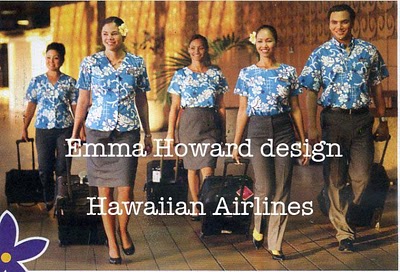
In 2012 Hawaiian Airlines commissioned textile designer Emma Howard to design the Hawaiian pattern for the new uniforms. They are wonderful.

Where does Hawaiian Airlines find its people?  To a person, they were flawlessly personable and helpful.  When we arrived at the airport in Honolulu to catch our flight to Kaua’i we were hopelessly confused at the baggage drop-off.  And we were not alone.  The system did seem a bit foreign, but helpful agents were able to get us in the right line, and now we know how to navigate their system.  (Let’s face it, the variations in policies regarding check-in and baggage drop off among airlines throughout the world is mind-boggling.  It would be nice if they could get it together.  This is a tall order, we fear though, since even the security screening rules differ wildly from one airport to another even in the same country – shoes on, shoes off, cases in a bin, cases not in a bin, sweaters on, sweaters off, aahhh…you understand and we’re digressing).

We were flying first-class on these flights, but since the distances are short and many of the airports small (not the case in Honolulu) we did not expect many amenities.  We were surprised to learn that there are indeed first-class lounges in all the airports and more than one in Honolulu.  Decorated in Hawaiian motifs, the lounges don’t offer much in the line of food or drink – not necessary in these cases – but they are quiet, air-conditioned oases.

We heard a number of announcements indicating that Hawaiian Airlines was pleased to offer their customers advanced seat selection which suggested to us that the change was fairly recent.  Wonderful!  Actually, the reason we booked first class was because of our fear of the panic for seats as a result of our initial experience.  We needn’t have worried.

Once on board, the flight attendants were happy, helpful and fitted with delightful Hawaiian-inspired uniforms (with prints designed by Hawaiian textile artist Emma Howard) that made us smile.  On these short flights, they even managed to get us a drink and a snack – Mai Tai’s were our drink of choice!

The people were wonderful—but perhaps even more impressive was the efficiency of this airline.  With a mere 30 minutes turn-around time on each occasion, they managed to get the passengers and their luggage off the planes, the embarking passengers and luggage on and get away on time, all without seeming rushed.  The morning we flew back from the Big Island to Honolulu on our way home, there had been a computer glitch earlier in the day that had caused some delays.  Our flight arrived in Kona 10 minutes late, and with that planned 30 minute-turn-around we fully expected to be late, a situation that might have resulted in rushed connections.  Not to fear, though!  They still managed to get luggage and passengers off and on, and take off on time – a turnaround time of 21 minutes!

You might be thinking that we’re talking about a little turbo-prop plane with few passengers aboard, but they fly 717’s on these routes.  These full flights had 123 passengers on board and they still managed it.  We watched the baggage handlers efficiently moving luggage on and off the planes, and it seems to us that employees from other airlines could learn a thing or two.  In all our years of travel we have never experienced such fast arrival of our luggage – and that goes for small airports throughout the Caribbean.

Despite the fact that Hawaiian Airlines is not a member of the Star Alliance and thus we did not accumulate any frequent flyer points for the four flights we took, we enjoyed every minute of it, will do it again (may try one of their trans-Pacific flights next time) and would recommend them to anyone!

* Photo sources: http://mauinow.com/2011/10/10/hawaiian-airlines-adds-fifth-new-airbus/;

http://4.bp.blogspot.com/_nXFbQ8i7KNE/S8YGptkRNQI/AAAAAAAAACc/UT_kCoH5KjM/s400/Hawaiian

Choosing a cruise: A discerning guide to getting it right!

The "fun ships" were on the agenda in the early days. Art & Ian going ashore in the Caribbean from the Carnival Triumph (back in the day).

We’re about to embark on cruise number eleven.  Eleven! In the winter of 1999 when we made a decision that our family vacation would be on a cruise ship, little did we know that we’d be hooked.  And little did we know that we’d become (if you’ll pardon the expression) cruise whores.  You see, over the years we have not been happily loyal; rather we’ve been happily jumping from one cruise line to another, every once in a while returning to an earlier favorite – but moving ever up the cruise food chain so to speak.

But, what exactly motivates a discerning traveler in making a decision about which cruise to choose?  There are lots of different reasons to choose one cruise over another, and the truth is that the priority you place on one over the other can and will change as you become more discerning in your travel planning.  The most important factors are the following:

  • Amenities
  • Itinerary
  • Price
  • Overall experience

…come along with us as we share a few stories of how these factors played into our decisions over the years.

Let’s start with amenities.  Back in 1999 we were traveling with a 10-year old.  We began our search for the perfect cruise by chatting with our travel agent.  Rule number one for cruising: Always, always, always use a travel agent.  We’ve extolled the virtue of our travel agent before, but it’s so important when you’re planning a cruise.  They have access to information that you don’t have and can be your go-between through the planning process.  They can also hold a booking for you while you decide on flights, hotels etc.  Back to the plan for the first cruise.

A young Ian poses in the (little) verandah stateroom aboard the Carnival Triumph.

“Well,” Alan our travel agent said to us at the time,” I’m going to recommend Carnival.  Now, if it were just the two of you, I would never recommend them to you.  But with a kid…”  So, Carnival it was.  A week-long Caribbean voyage on a sparkly, new ship with a recommended children’s program seemed like a good way to get our feet wet (!).  Sparkly it certainly was!  The glitz, glitter and all that neon were a bit jarring, but fun.  Ian loved the children’s program and we immensely enjoyed our verandah stateroom with the third berth.  It was tight, but we didn’t know that it could be any bigger.  Oh, how times change.

Alan was right – as he always was.  It was not a cruise that we would have gone on just the two of us.  Drunken spring breakers spent the full week on the deck, never once making it to the dining room.  Oh well, it meant that dining was a relaxing event with lots of staff to cater to our every whim.  But, would we ever go back on a Carnival cruise?  You couldn’t pay us!  All that neon, glitz and partiers are not our style.  So, amenities in the form of a great children’s program led us to begin our cruising life, but amenities as a priority decision-factor has changed over the years.

So, then there’s itinerary.  Where is the ship going?  Probably the time that this issue was most important to us was when we decided to spend our 20th wedding anniversary on a Mediterranean cruise.  So, we began by searching for a great Mediterranean itinerary.

Art & Ian celebrate our sail-away in our Queen's Grill suite aboard the Queen Mary 2.

We’d been on Holland America in the intervening years, but Celebrity was offering really interesting cruises starting in Barcelona.  So, in the end, the itinerary that would take us from Barcelona to Marseille, Monte Carlo, several stops in Italy, Corsica and Northern Africa entranced us sufficiently that we booked our celebration aboard the Celebrity Century. And we decided to treat ourselves to a Royal Suite.   As we’ve mentioned before – once you go up to a suite, there’s no going back! And so to the discussion of price…

Discerning travelers are always looking for value.  That means that we’re judicious about how we spend our money.  This means that price is not the guiding principle for us in choosing a cruise.  And perhaps you might consider putting it a bit further down your priority list as well.  Hear us out.

Your enjoyment of a cruise will never be based on its price.  Obviously, we all have to stay within our budgets, but we assure you that you’re playing Russian roulette with your holiday money if all you go on is price (that is of course unless you plan to eat and drink yourself into a stupor  so that you don’t notice anything else– in which case you could do that on your own couch in our view).  We’ve been listening and observing through the years, and we have concluded that it is safe to say that not every cruise line is for everyone.

Recently, a colleague of Art’s returned from a family cruise aboard a line that we have always avoided.  Knowing ourselves the way we do, it seems that we were right to do so.  The colleague complained that it was so laid back and casual that people even dined (in the main dining room) wearing T-shirts and ball caps.  If that’s your style, go for it – but we would not enjoy that, and neither did she.  So, you really do need to do some research – and travel agents are the best place to start.

And this brings us to the all-encompassing decision-making factor: the overall experience.  Lately, this has been our guiding principle.  What kind of ‘experience’ do we want?  We clearly chose last summer’s trans-Atlantic crossing on Cunard’s Queen Mary 2 because we wanted to experience the traditional voyage on a ship purpose-built for these kinds of crossings – we didn’t want to be on a re-positioning cruise.  Several years earlier, we chose a Holland America holiday cruise when we wanted to spend Christmas at sea en famille.  At that time, the overall experience we were seeking was Christmas at sea some place warm.  They did not disappoint!

Clearly, we do enjoy a bit of dress-up. We pose on the Queen Mary 2.

It’s hard to categorize the kinds of experiences that you want, but here are a few questions you might ask yourself before you spend your hard-earned money on the cruise of a lifetime:

  • Do you like to get dressed up once in a while, or do you prefer to wear your baseball cap to dinner?
  • Is the ship the destination for you, or are the ports more important?
  • Do you like to be surrounded by (other people’s) children, or  do you prefer the company of adults?
  • Do you need to have a place to retreat to (like your own verandah), or do you always prefer to be around other people?
  • Do you like quiet evening entertainment, or must you have a full-on, Broadway-type show?
  • Do you like glitzy extravagance, or does your personal style run more to the elegant?

Once you have answered these questions for yourself, you can take your answers to your travel agent and you’ve begun a discerning journey to a memorable (in a good way, we hope) cruise vacation.

Our own answers to these questions led us to our upcoming Puerto Rico to New York via Bermuda cruise with a revisit to a Royal suite.  We’ll let you know how that goes!