New Year’s Eve Celebrations: Ringing in the new year away from home

happy new yearWe’re staying home this year for New Year’s. We’ll happily dine at ‘Blu’, one of our favourite Toronto restaurants, then crack open a bottle of Veuve Clicquot, our favourite champagne when we get home around midnight. We’ll probably reminisce about this past year (and why we didn’t travel/blog as much – we moved) and then think about what the year ahead might bring (traveling to begin in precisely two weeks). But we’ll also pull out photos of two of our most memorable new year’s away from home. Just a couple of years ago we spent two very memorable first night celebrations in the one place in the world where they really know how to party with sophistication and elegance: Monaco.

The day begins with a visit to the local Carrefour. A gigantic grocery store that rivals Wal-Mart for its variety and Whole Foods for its quality, the place is a zoo at the best of times, but New Year’s Eve is special. We begin (and it has to be said, end) at the extensive wine section. The sheer array of French wines that begin at about 3 euros a bottle and go upward from there is dizzying. The problem is that we have rarely had a bottle from Carrefour hat we didn’t like. So how to choose from among all of these unknown bottles?

Our usual tactic involves stealth observation. Watching the men and women going up and down the aisle filling their baskets and carts to the brim with bottle after bottle is the best place to begin. Then we get a bit more discerning.

We look at how many bottles of each kind of bubbly make their way into how many baskets. Then we watch the individual purchasers. Are they old enough to have experienced a bottle or two? Is the twist of their scarves just stylish enough to imply a bit of je ne sais quoi? Are they assured enough of their choices that there is no waffling? When all systems are go, we swoop in and choose the right bottle of champagne – and make no mistake, it is always right. But then where to drink it? We’re getting to that.

The day is young so we’re inclined to wander a bit through the Monte Carlo Christmas market where we’ll indulge in the decadence of a glass of quality champagne outdoors from a plastic flute. We’ll watch the skaters take a turn around the temporary rink on the MC waterfront, as ludicrous as that seems.
DSC00325
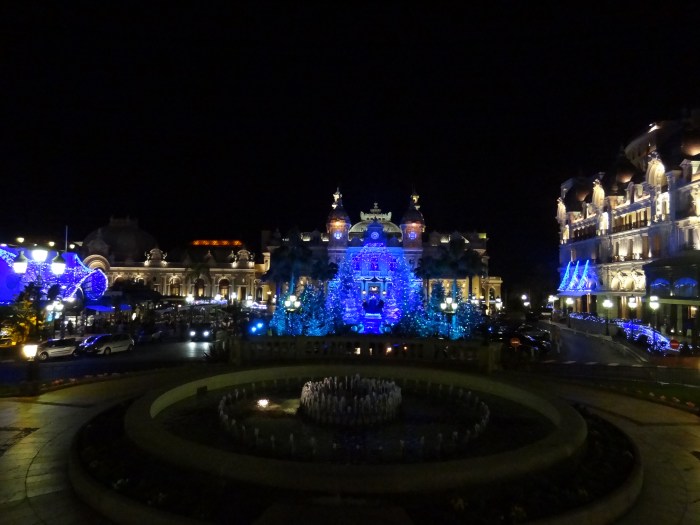
Casino Square in Monte Carlo makes a magical scene dressed for the Christmas season.

Then we head back to the hotel to get dressed. We’re going to the ballet this evening. We don our finery and make our way to the Grimaldi Forum with what appears to be the majority of the Monagasques themselves.  Situated on the shore of the Mediterranean, the building is actually built right into the Med with the main performance space where we’ll see Les Ballets de Monte Carlo dazzle their home crowd below sea level. Down, down, down, three very long escalators to reach the entrance to the orchestra seating. We sip more champagne while we people watch.  Can there be a more decadent place to people watch than MC?

We spot Louis Vuitton, Gucci, Chanel, D & G, Hermes, all milling around the bar dangling from shoulders and elbows. Then the bell chimes three times – five minutes to curtain time. As we take our seats Patty puts her handbag on the hook on the back of the seat in front of her. Such a thoughtful touch: the designers must have thought of all those expensive handbags that would grace their auditorium through the years. We then glance surreptitiously toward the royal box to see if Princess Caroline might be gracing New Year’s Eve with her presence since she is, after all, the president of the ballet company. Then the curtain rises, the orchestra begins, and we’re transported into the rarefied world of the ballet thanks to our son the dancer who is sharing the stage with his colleagues.

The ballet is over at 11:30, and all of us spill out into the Mediterranean night that is lit with hundreds of thousands of twinkling lights. We make our way up the hill to the casino square where side by side with the palm trees lit for the season are 50-foot high fir trees brought in and decorated so that the lights change colors. We are transported along with the crowd.

Once in the square which is already shoulder-to-shoulder full of well-dressed revelers, we get into the spirit of the night. The countdown begins. “Dix-neuf-huit-sept…deux-un! Bonne année!” And the corks begin flying! Pop! Pop! Pop! Then splash! As the champagne is poured from bottle to plastic flutes as everyone wishes anyone around a happy new year.

Coming as we do from North America, the very fact that it is perfectly acceptable for this crowd to pop their champagne corks in this very public place and enjoy a sip of New Year’s bubbly makes us just a bit giddy. We are delighted and know that it will be a good year, indeed.

Happy New Year to all our readers. We promise that we’ll resume our story telling in 2016.

[If you are a long-time reader and think you may have read about this New Year’s adventure before, you have. Much of this post is excerpted from our New Year’s post from 2012. But we still think it’s a great story. Hope you do too.]

A cruise ship medevac: Not the usual travel experience

DSC07319Travel for us is about experiences.  Sometimes it’s the places we visit; sometimes the people we meet.  Other times it’s the food we eat or the wine we drink.  All of these form the experiences of the discerning traveler.  But sometimes, experiences are unexpected and not related at all to where you’re visiting.  A few months ago, while aboard the Oceania cruise ship Nautica, we witnessed a helicopter medevac as we sailed the Mediterranean off the coast of Greece.  And our thought was this: It could have been anyone of us.

It all started a few hours earlier as we sailed peacefully on our way from Malta toward Crete.  We had noted only peripherally (as you do when you’re enjoying the only day at sea in an itinerary-rich cruise) that the ship seemed to have sped up.  The onscreen information that continually streamed on a television channel from the bridge confirmed this suspicion, and we had also slightly altered our course.  We thought little of it.

Half an hour later the Captain took to the public address system to tell us that we had indeed altered our course so that we could get closer to mainland Greece in an effort to meet a helicopter from the Greek Coast Guard that would effect an evacuation at sea of a passenger who had fallen ill.  As we all know, cruise ships have well-equipped infirmaries, but there are some illnesses that require more than can be provided by these facilities, and by the single physician and nurse aboard.  This was evidently one of those occasions. And wouldn’t you know it?  It happened on the only day we weren’t in a port!

Evidently these kinds of thing happen more often than we might think – although in some fourteen cruises, we had never observed one.

An hour or so after the Captain’s address, we saw the helicopter approaching the ship.  The Captain had requested that everyone stay off the open decks for safety reasons – and we can only imagine that it would be an extra burden to the passenger and his wife to have onlookers curiously peering at them close-up.  Although some of the newer and much larger cruise ships these days have helipads, most don’t, requiring the helicopter to hover for a half an hour or more – as long as it takes to send down an emergency medical technician, secure the patient to the stretcher, hoist the patient up to the chopper, then hoist the technician and the passenger’s wife into the hovering beast.

Those of us with verandahs in the aft of ship had a view of the entire operation from beginning to end.  We were impressed with the efficiency of it all, and the coordination it took to get such an international rescue underway so quickly.  We were just happy that it wasn’t one of us.

Several days later, we happened upon the ship’s doctor on an elevator and Art, who in his past has actually done a stint as a ship’s doctor, enquired about the outcome of the medevac. The doctor said that the patient had evidently had a stroke and the medevac was successful.

Consumer Reports covered the subject of medical care at sea in a blog post last year.  Among the seven things they suggest you need to know are the following:

  1. The medical facilities at sea are not the same as your local hospital with respect to either equipment or staff.
  2. Medical care at sea is expensive. Be prepared for sticker shock, as they say.
  3. If a ship is 500 or more miles away from shore, “it’s unlikely the Coast Guard will respond.”[1]

As discerning travelers, we are always aware that these kinds of things can happen.  We try to minimize it by being healthy when we leave, and taking a few precautions while we’re away (such as hand-washing, staying away from buffets etc.).  Unexpected things do happen, though. We never leave home without travel medical insurance.  And we are always sure to read the fine print!

We’d like to share with you the video we took of the medevac.   Travel often and stay well!


[1] http://www.consumerreports.org/cro/news/2014/04/7-things-you-need-to-know-about-medical-care-on-cruise-ships/index.htm

Welcome to Rome: A cautionary tale about Leonardo Da Vinci Airport

The Boscolo Grand Palace Hotel, our home away from home in Rome. We were very happy to finally get there from the airport!

We had been to Rome twice before, arriving by ship both times.  Just this past fall, we flew into Rome and landed for the first time at Rome’s Leonardo Da Vinci Airport, its international airport in Fiumicino.

After three wonderful days in London, we had made our way to Gatwick for the short flight to Rome, anticipating our three days there before setting sail for the Greek Islands and Istanbul.  In spite of all the woes of airline travel these days, we were still excited to be making our way to the eternal city.  An hour later in Rome’s airport we were beginning to doubt our modus operandi.  To say that the luggage handling was lengthy would be an understatement, and there was a distinct lack of any customer service for British Airways passengers.  However, after a rather impatient wait, the luggage finally arrived.  We were ready to take on Rome.  Or so we thought.

We made our way out the doors of the international arrivals into a sea of people waving placards announcing the names of their passengers who had pre-booked their taxis.  We often do this, but we’ve had to wait so many times for our taxi drivers – especially at Heathrow – that this time we decided to wing it.  Mistake number one.

As we made our way through the crowd, Patty spied – or was spied by – a man sporting a lanyard which presumably identified him as an official taxi driver.  As throngs of people passed by, he asked us if we were looking for a taxi.  “Yes,” Patty said, immediately after which he grabbed her suitcase from here and propelled his way through the crowd toward the door where the taxis waited in a queue at the curb.

He maneuvered his way past this line to a waiting car just beyond and thrust our suitcases rapidly into the trunk.  He smilingly opened the door and ushered us into the back seat which we obligingly let him do.  Mistake number two.

There was already a man in the front passenger seat.  We wouldn’t mind sharing the cab with his brother, would we?  We actually did mind, but it seemed unfriendly in the face of their clear friendliness to tourists, and he was already there.

There was no visible identification inside the vehicle and no meter.  He began to pull away quickly as Patty asks him, “How much?”

“Just tariff,” he says.

Patty presses him.  “Could you be more precise?”

The driver sighs and pulls out a laminated card from a pocket.  We look at it.  It is this moment where we know without any doubt that we have “been had” as they say: 100 Euros for a trip from the airport didn’t seem right.  After all these years of traveling, we have managed to avoid most of the travel scams and consider ourselves to be quite savvy.  This time we weren’t.  But it wasn’t over yet.

The joys of modern technology meant that we were able to immediately pull out a cell phone and track our route on Google maps so that we could be assured we were actually taking the direct route to our hotel, a tactic we highly recommend in any city you don’t know well.  We followed the dot all along.  The friendly driver and his friendly brother were both aware of our tracking, but were not aware that Art had, in fact, also searched out and discovered that the tariff would be closer to 40 Euros.

We finally arrived at our hotel, the driver pulling up to the curb far enough past the hotel that the bellman didn’t immediately realize we were guests of his establishment.

We were both out of the car quickly, pulling our suitcases from the now-open trunk (which the brother didn’t’ want us to do), before the driver demanded 100 Euros.  Art passed him 40 Euros which resulted in an angry rebuttal about the fare.  At this point, the bellman at the hotel noticed us and immediately came over to assist with our luggage.   As the bellman took our luggage for us, Art asked him what the normal tariff from the airport to this specific point in the city would be.  He indicated that it was between 40 and 50 Euros, so Art pulled out another 10 Euros and gave it to the brother who was still demanding a hundred.  We firmly paid the 50 and followed the bellman and our luggage into the hotel, not looking back. The bellman was appalled at the audacity of his countrymen.

In retrospect, we realized we should have been savvier, but we had been anxious to get away from the throngs at the airport.  We should have lined up for the taxis in the official line and been patient.

On occasion, however, you might find that you don’t have much choice. We recommend that you get the fare sorted out before you put your luggage in the trunk of the car, even if you have to restrain the driver – which we would have had to do.  Then get out your cell phone and track the route (make sure you have a roaming package before you leave home!).  We learned a lesson – we hope you might benefit from it.

Walking a city: The only way to get to know it

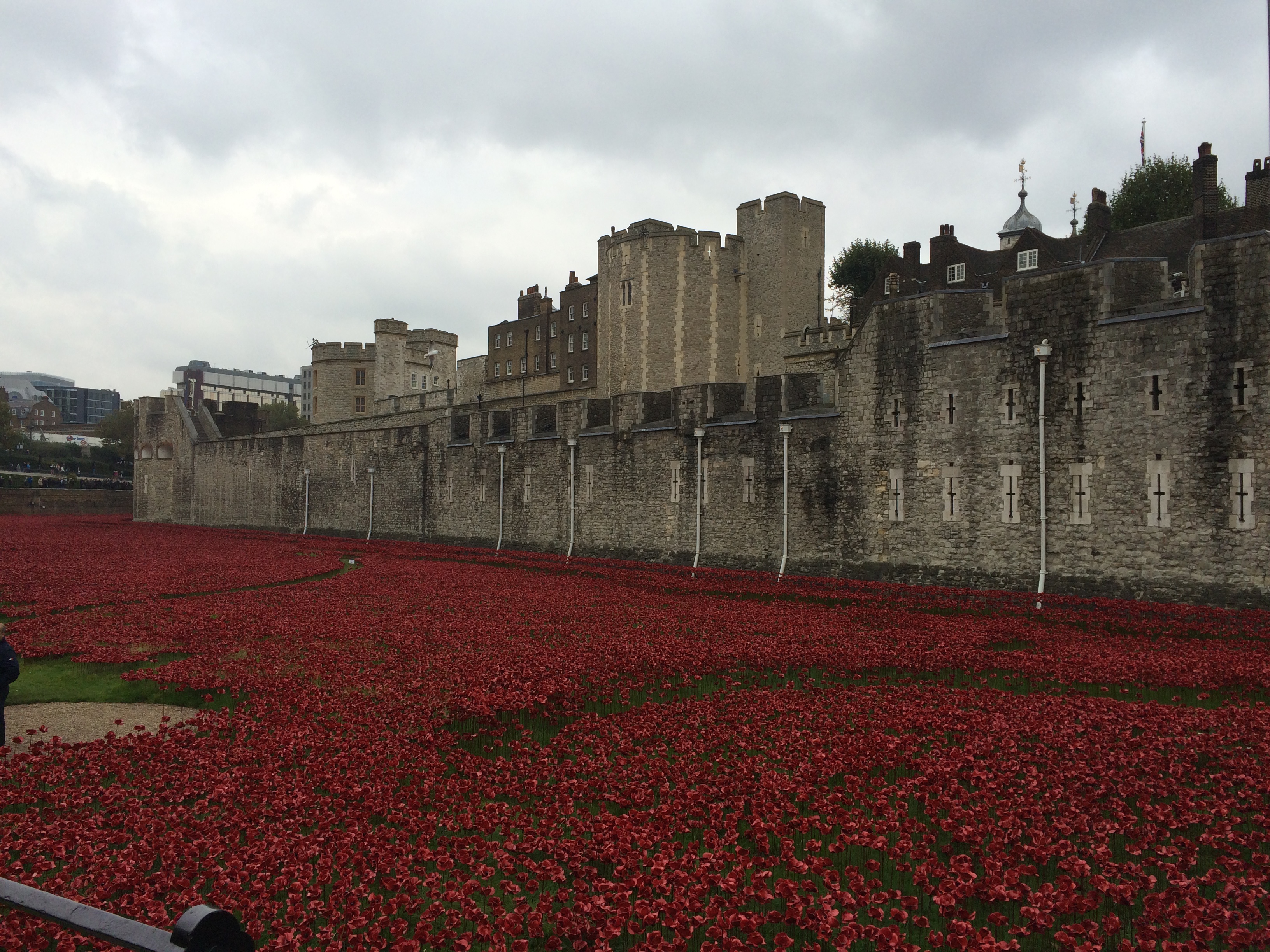
In October of this year the Tower lf London was home to a magnificent display of ceramic poppies to honor the WW I veterans.  A stroll around it was the only way to appreciate it.
In October of this year the Tower of London was home to a magnificent display of ceramic poppies to honor the WW I veterans. A stroll around it was the only way to appreciate it.

We’re now ensconced back home in Toronto and walking this beautiful downtown is how we get around: how we buy groceries, how we go out to dinner, how we appreciate all it has to offer.  This last consideration is one we take to heart when we travel abroad.

In October we revisited London (the fact that our youngest son makes his more there now is an added benefit).  Every time we venture across the pond to this other marvelous city, we stay at different hotels in different parts of the city.  In fact, in recent years, we’ve stayed at five different hotels each of which is centered in a different district or neighborhood of London.  On this last visit, we stayed at the wonderful Threadneedles Hotel.  Threadneedles is located right in the heart of the “City of London”, that single square mile of real London town.  Housed in a building that was originally home to the City Bank of London, this boutique property exudes a timeless elegance that draws you into the history of this venerable city.  On each of our three days there, we headed out in the morning to walk different directions – never treading the same street twice is our motto when walking a city.

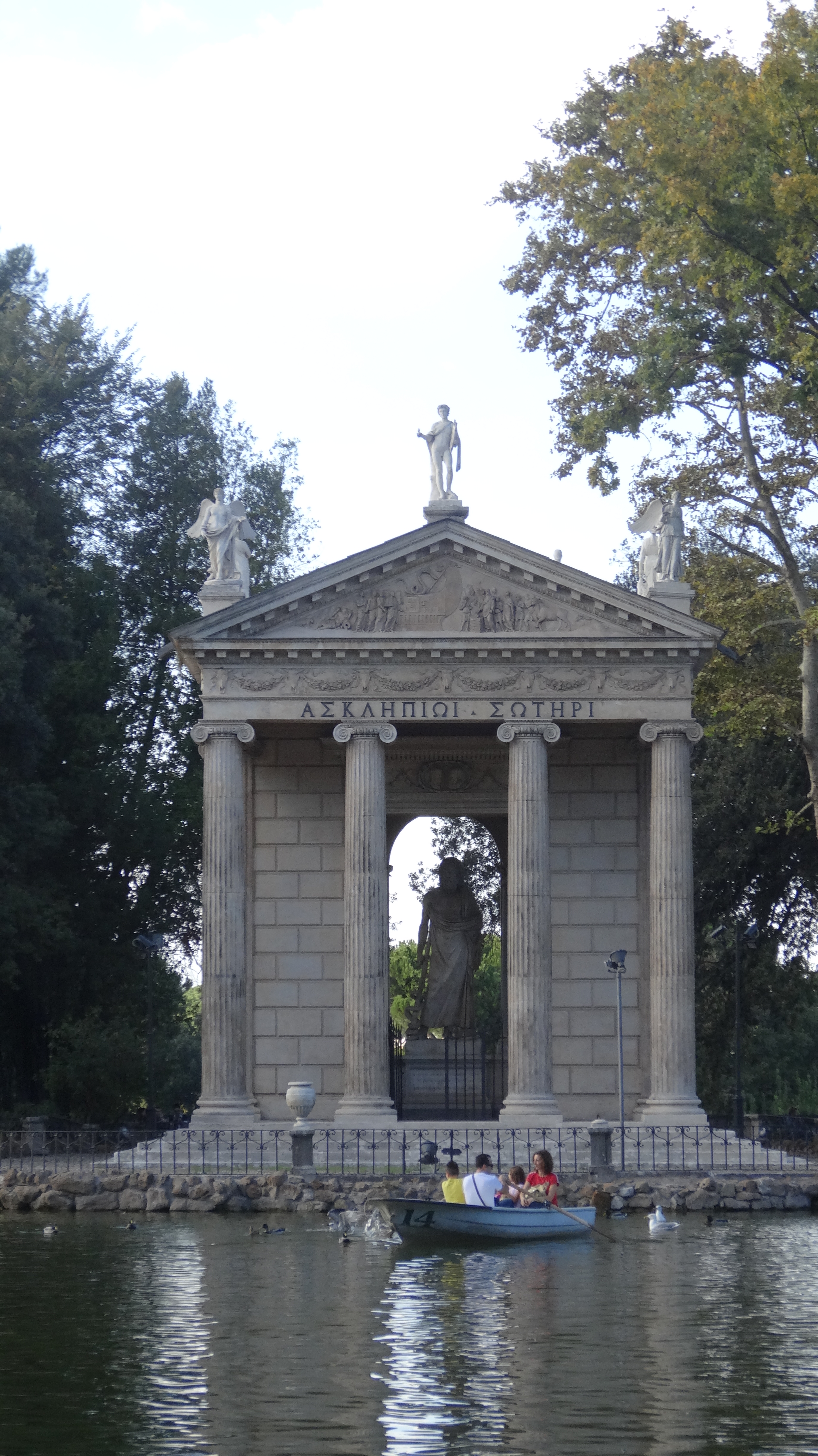
A walk through the Borghese Gardens brings you to many delightful places you simply cannot see if you don't get out and walk.
A walk through the Borghese Gardens brings you to many delightful places you simply cannot see if you don’t get out and walk.

We then flew from London to Rome, a city we’ve visited several times before, each time for only a day trip from a Mediterranean cruise.  Although we had seen the highlights of the tourist sites: the Vatican (hours and hours spent there on one visit, the Colosseum, the Spanish Steps,  the Trevi Fountain etc.) – we had never really been able to get a feeling for the city of Rome.  This visit was different.  We walked.  In fact, one day we walked eight miles!  How do we know this?  We find it interesting to always wear a pedometer when we travel.  Knowing how far we walked is the best rationalization for all that wonderful pasta we ate and Barolo we drank.

Our last stop on this visit was the magnificent city of Istanbul.  We stayed at the fabulous new Marriott Hotel in the modern Istanbul, a couple of kilometers north of Taksim Square.  Although that might seem counter-intuitive to anyone who wants to spend time walking around the old city of Istanbul where the main historical sites are located, the fact that we weren’t confined to that relatively small area was a real bonus.  We walked around the modern city to get a feel for the everyday life of Istanbul’s 15 million residents!  Although we didn’t walk around the Asian side where a large proportion of the residents actually live, the modern city of Istanbul did provide us with a sense of the

A walk through the Spice Market in Istanbul uncovers more than spices!

city.  Of course, sitting high above the city each evening overlooking both the old and new parts of the city along the shores of the Golden Horn with the Blue Mosque shining in the distance was an added benefit from the top floor lounge in the hotel.

Then our driver and guide picked us up to take us to the historical sites (read about our fantastic private experience in Istanbul here).  We walked through museums, palaces, the Grand Bazaar, the Spice Market, and market streets that cater only to the locals.  We would never have had that opportunity without our guide!  But with or without a guide, walking is our recommended method for seeing a city.

Get out of that taxi or off that bus.  And for heaven’s sakes, get above ground and out of that subway or tube!  You’ll never get to know a city that way.